Buchule Jack (BComm 2008) traded his office job for farming in the Eastern Cape and breaks stereotypes.
Kim McFarland (BComm 1986) steps down as executive director of Investec and announced as new CFO of Ninety One.
Derek Wilcocks (BEconSc, BEconScHons 1993) offers advice to young technologists on the growing role of technology which is crucial in today’s data-driven business.
Professor Mervyn King(BComm 1969, LLB 1960, DLitt 2008) former Judge of the Supreme Court and Chair of the King Committee on Corporate Governance in South Africa welcomed at Wits Business School as Honorary Professor.
ENGINEERING AND BUILT ENVIRONMENT
Simon Baloyi (BSc Eng 2000, MSc Eng 2002) brings new energy to Sasol and is appointed as Senior Vice-President of Secunda Chemicals Operations.
Dineo Lioma (BSc Eng 2011) shares her big plans on using artificial intelligence in medicine.
Director of Wits Business School and BCX chair in digital business,Professor Brian Armstrong (BSc Eng 1982, MSc Eng 1985), shares useful insights on the future of work.
Dr Paul Roberts (BSc Eng 1980, PhD 1990) celebrated for his dedication to the field of engineering.
MEDICINE
Dr Francesca Conradie(MBBCh 1988, DTM&H 2000) co-authors a study which proves successful in treating drug-resistant TB.
Professor Glenda Gray(MBBCh 1986) outlines why the historic HIV Vaccine Clinical Trial has been stopped in South Africa.
Professor Frederick J Raal(MBBCh 1981, MSc 1991, PhD 2000) Head of the Division of Endocrinology and Metabolism at Wits and lead author of the Phase 3 trial that reduces cholesterol to near-normal levels among patients with a cholesterol disorder.
HUMANITIES
Barbara Adair, who works part time at the Wits Writing Centre, has a new enigmatic novel that transports readers into seductive and dark worlds.
Kenneth Creamer (BA 1991, BA Hon 114, LLB 1995, LLM, 1997, PhD 2010) provides a brief explainer to Tito Mboweni’s Budget Speech.
William Gumede (MA 2003) offers youngsters guidance on how to stand for their values.
Candice Chirwa(BA 2017) tackles period shame in TEDx talk. Nonjabulo Gumede (BA 2017) expands her conversations about identity politics in Africa.
SCIENCE
Professor Bob Scholes (BSc 1978, BSc Hon 1979, PhD 1988) from the Global Change Institute at Wits explains that spekboom isn’t more effective than the Amazon rainforest at sucking carbon out of the atmosphere.
Dr Ashleigh Jane Hutchinson, deputy director of the DSI-NRF Centre of Excellence in Mathematical and Statistical Sciences and senior lecturer in the School of Computer Science and Applied Mathematics at Wits, argues mathematical modelling can be used to understand the Eskom crisis.
Alumni in the news April 2020
-
Witsies making the headlines
COMMERCE, LAW AND MANAGEMENT
Kyle Pillay (BAccSc 2016) earned a place on South African Institute of Chartered Accountants’ prestigious Honours Roll. The roll is made up of 12 candidates who demonstrated exceptional performance and insight in the way they completed case-study tasks. Read his career projections, lessons learned from his journey here.
Christopher Malikane (BSc 2000, MCom 2002), Associate Professor in the School of Economics and Finance at Wits, asks if the South African Reserve Bank is practicing quantitative easing.
Fhedzisani Pandelani (BProc 1993, LLB 1995, HDipColLaw 1996), chair of the Gauteng Liquor Board, has been appointed as South Africa’s first solicitor-general for two years by justice and correctional services minister Ronald Lamola. He faces a huge task to tackle the state liability bill.
Mpho Manyala-Chitapi (LLB 2013) was the black female partner at Africa’s largest law firm, ENSafrica before Nedbank appointed her as the Head Legal: Group Technology. She shares how she balances her work and the burden of “black tax”.
ENGINEERING AND BUILT ENVIRONMENT
Hannah le Roux (BArch 1987, MArch 2002), Associate Professor of Architecture at Wits, shares four ideas from history that offer healthier design.
Cikida Gcali (BSc Eng 2014), Senior Customer Strategy and Operations Manager at UberEats, shares how to handle the challenges that come with being a black woman in a male-dominated space.
Maemo Machaba, a civil engineering student as well as Managing Director at Aura Entle Engineering and Construction, is part of an engineering trio who developed a unique technology to build double and triple-storey houses without using pillar support. He shares how they were provided resources to be innovative.
Alboricah Tokologo Rathupetsane(BSc Eng 2016) has been shortlisted for the prestigious Commonwealth Short Story Prize for 2020 for her submission of “The Faraway Things”. Listen to Alboricah talk about her submission here.
ProfessorMitchell Gohnert(PhD 1995), from the School of Civil and Environment Engineering, has contributed to a vital resource on construction techniques in precast, 3D printing and shell structures through the TCI Information Centre. This operates as a public concrete technology library and is accessible to anyone in South Africa interested in or needing information on concrete topics.
Simo Mkhize (BSc Eng 1997) has been appointed as new chief commercial officer Cell C. He holds an MBA from Milpark Business School, a postgraduate diploma in telecoms from BPI College in Austria and a BSc in electrical engineering from Wits.
MEDICINE
Dr Susan Williams (MBBCh 1994, MMed 2009, PhD 2013), senior Lecturer in Opthalmology at Wits, writes African genetic studies offer hope for preventing a common cause of blindness.
HUMANITIES
Elaine MacDonald(BA Hons 2003) author, scriptwriter and children’s television presenter has launched her second book I See a Rhinoceros through Penguin Random House.
Storyteller and entrepreneur Juliet Vuyiseka Rozani (BA DA 2014), launches a children’s book Azira: The African Princess, a story about a girl whose heart is filled with kindness.
Kundai Moyo (BA Fine Art), a Zimbabwean-born artist, has been selected to join the KZNSA Gallery for its second season of the Young Artists’ Project. She considers questions around love, and its conduits: care, recognition, respect and intimacy.
Dr Nduka Mntambo(BA DA 2006, MA 2010) is the Head of Film and Television programme at the Wits School of Arts. He won Best Visual Art award for his installation Asymmetries at the 2020 Humanities and Social Sciences Awards. The awards honour scholarly work based on social relevance and contribution to the humanities and social sciences. See more of his work here:
Artist Serge Alain Nitegeka (BA Fine Art 2010) is profiled in The New York Times. He shares his art and the refugee condition during a time of global lockdown.
Candice Chirwa (BA 2017) is an author, professional speaker and radio host. She is known as the “minister of menstruation” because she of her activism which makes menstrual education fashionable.
SCIENCE
Dr Kimberley Chapelle(BSc 2013, BScHons 2014, MSc 2016) and Professor Jonah Choiniere from the Evolutionary Studies Institute at Wits published in Scientific Reports. They found present 3D reconstructions of the 2cm-long skulls of some of the world’s oldest dinosaur embryos show similarities to today’s crocodiles, lizards, and chickens.
Professor Lee Berger (PhD 1999, DSc 2014), Chair in Paleo-anthropology from the Evolutionary Studies Institute at Wits, explains how fossil skulls rewrite stories of ancient two ancient human ancestors.
He also produced a series of online video lectures giving a fascinating inside look at the University’s world-renowned fossil vault.
Alboricah Tokologo Rathupetsane
-
Witsie shortlisted for 2020 Commonwealth Short Story Prize
Alboricah Tokologo Rathupetsane’s (BSc Eng 2016) short story “The Faraway Things” has been shortlisted for 2020 Commonwealth Short Story Prize.
The prize is awarded annually for the best piece of unpublished short fiction from any of the Commonwealth’s 54 Member States. It is the only prize in the world where entries can be submitted in Bengali, Chinese, English, French, Greek, Malay, Portuguese, Samoan, Swahili, Tamil, and Turkish.
The stories on the 2020 shortlist were selected from 5107 entries from 49 Commonwealth countries.
Chair of the Judges, Ghanaian writer and editor Nii Ayikwei Parkes, said: “At a time like this, with the world beset with myriad challenges and a devastating virus, the stories are grounded in faith, hope and the humanity we all share.”
The judges will go on to choose a winner for each of the five regions. These regional winners will be announced on 2 June, before being published online by the literary magazine Granta. The overall winner will be announced on 7 July.
Alboricah grew up in a rural village in Limpopo, but lives and works in Port Elizabeth. She told Wits Alumni Relations that her writing offers a welcome balance to the technical writing and maths she encounters in her day job as an engineer. She completed a version of the traditional Proust Questionnaire:
What is your idea of perfect happiness? The freedom to do anything I want, whenever I want.
What is your greatest fear? Disappointing my mother
What is the trait you most deplore in others? Laziness and fear of taking risks.
What is your greatest extravagance? Art supplies and books. I love drawing and painting. I can buy the most expensive set of paints and canvasses and not blink over the cost. I can also splurge on books, especially ones I’ve been anticipating.
What is your current state of mind? Pragmatic. I’m always looking up art and writing competitions to participate in since we’re now spending so much time at home. I try to write and draw as much as possible, also just for enjoyment. My mind is currently very open to creative stimuli.
What do you consider the most overrated virtue? Patience (good things come to those wait)
Which words or phrases do you most overuse? “To write/draw/read/(any verb) or not to write/draw/read/(any verb)? That is the question.”
When and where were you happiest? When I was 17, my little sister was born. I’d always wanted a sister and could imagine us being best friends in the future and ganging up on my brother.
Which talent would you most like to have? Linguistics and martial arts. One of my goals is to travel the world and experience different cultures. I love hearing different languages and often attempt the phrases I manage to remember. I also like fancying myself a ninja sometimes, prancing about gracefully with insane flexibility. I crave that total control over your physical being.
What do you consider your greatest achievement? Completing book 1 and 2 of a series I started writing in high school.
If you were to die and come back as a person or thing, what would it be? I’d want to come back as an astronaut in a time when there’s interplanetary travel.
Where would you most like to live? Somewhere close to the ocean, in a cute nature-nestled cottage, but somehow within access to a lot of modern day conveniences (libraries, dance clubs, cinemas).
What is your most treasured possession? My book collection and my external hard drive (has collection of south korean dramas).
What do you regard as the lowest depth of misery? Never trying anything because “it is your lot in life”. Accepting that circumstances can’t change or get better.
What is your favourite occupation? Reading
What do you most value in your friends? They introduce me to new things because they know I like new experiences. Friends that challenge me to go beyond my current efforts.
Who is your hero in fiction? V from the movie “V for Vendetta”
Which historical figure do you most identify with? Most accurate answer: My great great grandmother. She moved her family to land she decided would be more beneficial to their livestock (ours was one of the first families to settle down in the village where my mother grew up). My great great grandmother also strongly believed that girls should be educated. Most well-known answer: Joan of Arc. I think had I been born in that era, I would have been capable of disguising myself as a man to achieve my goal.
What is your greatest regret? One of my closest friends passed away in 2017. I kept putting off going to visit her because I wanted to stock up on leave days from work (therefore have a long visit). When she passed away, I realised that I should have just gone to see her without trying to make a vacation out of it.
What is your motto? Take chances and make the most of every single day.
COVID-19: Alumni adding value
-
Wits alumni and friends of the university contributed greatly to the COVID-19 debates during May. Read here to catch up on them.
COMMERCE, LAW AND MANAGEMENT
Professor Dori Posel, a Distinguished Professor in Commerce, Law and Management, joins eight other investigators in multi university collaboration a collaborative research project across three universities which will track the social and economic impacts of COVID-19 in South Africa. The study will survey a nationally representative sample of 10 000 South Africans every month for the next six months using telephone surveys, focusing on unemployment, household income, child hunger and access to government grants. The aim of the researchers is to inform policy-makers and help direct relief efforts to where they are most needed, and to determine if those relief efforts are working as intended.
Ondongo Kodongo, Associate Professor in Finance at Wits, speaks to Mike Siluma about the economic impact of COVID-19 and Africa’s response options.
Kendal Makgamathe, head of brand and business development in Tshimologong Digital Innovation Precinct at Wits, participated in the MIT community for COVID-19 challenge.
Dr Emile Zitzke, Senior lecturer in Wits School of Law, answers whether it is legal to disclose/publish the COVID status of another person.
ENGINEERING AND BUILT ENVIRONMENT
Nancy Coulson, Senior lecturer Wits Mining Institute and Nicola Christofides, Associate Professor in the School of Public Health at Wits put health and safety of miners in the spotlight.
Professor Fredrick T Cawood (GDE 1995, MSc 1997, PhD 2000) from the Wits Mining School writes about the implications of a lengthy lockdown in the mining industry.
Dr Peter Barrow (MBBCh 1997) chats in webinar on the gastro-intestinal manifestation of COVID-19. He also has extensive clinical and research experience in inflammatory bowel disease (ulcerative colitis and Crohn’s disease), celiac disease, oesophageal motility disorders and GERD.
Head of Immunology,Professor Elizabeth Mayne (MBBCh 2002, MMed 2009), has called on South Africans who have tested positive for COVID-19 to volunteer for a rapid study.
Lucille Blumberg (MBBCh 1974, DTM&H 1987, DOH 1991, MMed 2003) Deputy Director of National Institute for Communicable Diseases and member of staff, co-authors with Shaheen Mehtar and Marc Mendelson answer key questions for African countries moving to make wearing of masks mandatory.
Professor Lenore Manderson, Distinguished Professor of Public Health and Medical Anthropology in the School of Public Health, was part of a BBC panel discussion on living with ‘risk’ during COVID-19.
Crowdfunded medical graduate Retshidisitswe Kotane(BCMP 2018) excited to be part of the medical team in fight against COVID-19.
Professor John Gear(MBBCh 1967, Honorary Doctor of Science in Medicine) previously head of Public Health at Wits and founding director of Wits Rural Facility, currently Medical Director of the Tshemba Foundation, writes lockdown is not a viable strategy for South Africa.
Professor Glenda Gray(MBBCh 1986), head of the South African Medical Research Council mentioned in these articles related to tensions between scientists and government handling of lockdown regulations. Professor Gray was critical of the government's approach to lockdown, calling much of it "unscientific" and "nonsensical".
In the same article Professor Lynn Morris (BSc 1981, BSc Hons 1983) interim executive director of the National Institute for Communicable Diseases, said the use of risk-based approach in removing the lockdown is based on guidance by WHO.
Minister of Health releases a statement in response to criticism from Prof Gray here
M&G health editor explains context of the tussle between government and scientists here.
Medical Research Council launches investigation into Glenda Gray.
Rob Rose provides analysis here on the Medical Research Council’s decision to ‘discipline’ Prof Gray for her statements in Financial Mail.
Mark Heywood provides context on Prof Gray’s statement, which has not been addressed by government from Daily Maverick.
Grateful for support from SAMRC once it calls off investigation.
Chimaraoke Izugbara Professor-at-large at the School of Public Health at Wits co-authors with Mary Obiyan arguing more should be done to fight bogus COVID-19 cure claims.
Professor Bavesh Kana(BSc 1997, MSc 1998, PhD 2002) and Dr Bhavna Gordhan (BSc 1988, MSc 1989, PhD), from the South African Medical Research Council, make a remarkable achievement of harvesting live coronavirus as an additional control for validating tests.
Professor Shabir Madhi (MBBCh 1990, MSc 1999, PhD 2003) Professor of Vaccinology and Director of the Medical Research Council Respiratory and Meningeal Pathogens Research Unit at Wits writes with Marc Mendelson that South Africa’s testing strategy needs fixing
South Africa’s lockdown has reached its sell-by date in a webinar with Mark Heywood.
Discusses in a webinar with Ronald Abvajee that keeping schools shut disadvantage children because they are insignificant spreaders of the disease.
South Africa’s response to COVID-19 continues to face criticism in conversation here with John Perlman, Mark Heywood.
Co-authors a piece with Mary Metcalfe on shared responsibility of education departments, schools, parents and governing bodies on reopening schools.
Podcast series with 702, offers a profile of his work and explains mystery of stillbirths.
Writes with Professor Shaheen Mehtar and Professor Marc Mendelson that disinfection tunnels for COVID-19 have negligible benefit and are potentially dangerous.
She is profiled in this article aboutwhat it’s like on the front line at Charlotte Maxeke’s emergency department during the pandemic.
Dr Harry Moultrie, senior medical epidemiologist based at the National Institute for Communicable Diseases, is convenor of modelling projections of the pandemic in South Africa in coming months.
WithDr Gesine Meyer-Rath from Wits’ Health and Economics and Epidemiology Research Office during a presentation about the required ICU beds required. "We need an increase in ICU beds by a factor of 10… moving public sector patients into private hospitals will solve the problem for about two weeks in June, and then we will exceed the threshold.”
Projections of up to 5 000 COVID-19 deaths possible, 3 million infections by the end of the year.
Lise Jamieson, researcher in Internal Medicine division, profiled here as expert behind South Africa’s grim COVID-19 projections.
Dr Max Price (MBBCh 1979, DPH 1993) is a Non-Resident Fellow of the Centre for Global Development, and qualified public health expert and was formerly dean of the Faculty of Health Sciences at Wits. He makes sense of the “R” during the pandemic.
Dr Gesine Meyer-Rath, from the Health Economics and Epidemiology Research Office at Wits, argues that they are project an increase in numbers of hospital beds and equipment.
Professor Helen Rees, Executive Director of the Wits Reproductive Health and HIV Institute chairs the World Health Organization’s (WHO) African Regional Immunization Technical Advisory Group and says certain vaccines don’t work in some populations as well as in others. She is quoted in this story about Africa as research location in the race for a vaccine and drugs against the COVID-19 collaboration.
She discusses the trial and development of a vaccine with CGTN Africa here.
She tells Carte Blanche, everyone should consider that we’re going to be at risk and fundamentally change how we live about lifestyle from now on.
Profiled in 702 podcast series: She speaks about her origins of medicine aligned with ethics and care.
Dr Nokukhanya Khanyile (MBBCh 2015) vice president of Mental Matters, an initiative to destigmatize mental illness, is profiled here on her work and views on COVID-19.
Dr Duvern Ramiah (MBBCh 2002) writes how to get the most value from NOVEL technologies.
Professor Barry Schoub, Emeritus Professor of Virology at Wits, writes that communities should continue to stay vigilant.
Professor Francois Venter, infectious diseases at Wit’s Faculty of Health Sciences, comments that gains made in HIV and TB battles are lost because of COVID-19.
Trials at Ezintsha research group, collaborating with US-based Canary Health Technologies set to start in June for a rapid breath test for COVID-19. The trial will determine whether highly, non-invasive, disposable breath test can detect virus before symptoms occur. “We are very excited to partner with Canary on this game-changing technology. The holy grail is a real time, point of care device which can capture Volatile Organic Compounds or VOC as biomarkers."
SOCIAL SCIENCES
Aroop Chatterjee, Research Manager: Wealth Inequality Studies at Wits, argues the impact of COVID-19 will be shaped by the country’s inequalities.
Hannah Dawson (BA 2009, BA Hons 2010) Post-doctoral fellow at the Society, Work and Politics Institute (SWOP) at Wits offers reasons why South Africa needs to ensure income security beyond the pandemic.
William Gumede(MA 2013) Associate Professor from the Wits School of Governance, argues there could be a corresponding rise in nationalism and xenophobia with COVID-19, similar to 1930s.
Non-profit organisations need to be supported during this time. A similar thought says South Africa stands out as a country by not providing a cent for non profits, who account for 1, 5 million people working in this sector.
Years of government corruption, incompetence and indifference has severely undermined the credibility of government and allowing for a culture of impunity.
Erin McCandless, Associate Professor, School of governance at Wits and Darlene Ajeet Miller, (BA Hons 1990) Senior Lecturer, at Wits write that South Africa needs to forge a resilient social compact for COVID-19.
Alex van den Heever, Chair of Social Security Systems Administration and Management Studies, Adjunct Professor in the School of Governance argues we have not flattened the curve, our current trajectory of new infections is worrying.
The Western Cape is the only province with strategic COVID-19 testing.
Questions the rationale behind some types of data - particularly where cases were being found at what rate, and other contact tracing and screening data – being kept locked from public view. "We don't know what they have done and where. And that means I can't protect myself. A large part of managing an epidemic like this is you being able to take preventative action yourself, not just the government.”
Explains the expected surge of the pandemic as well as South Africa’s failed interventions in this context.
He mentions in this article that governments plans are the equivalent to “digging graves”.
Chats with Judge Dennis Davies about readiness of South Africa and possible projections and balance of risk ahead. Open as a default and close by exception.
Adam Habib, Vice-Chancellor at Wits, argues varsities encourage blended learning. The new approach to online classes as stop gap to teaching during this period of COVID-19 won’t be a replacement for face-to-face learning, rather it will serve as a complementary option.
How do we mitigate the deep inequalities in society. The appropriate response should not be because all cannot access, no one can. It is a flawed understanding of social justice. On Talking Point to Kathy Mohlahlana.
Writes an article with Imraan Valodia, Dean of the Wits Commerce, Law and Management Faculty, on how universities play a role in shaping new post-crisis world.
Fred Khumalo (MA 2015) writes lockdown restrictions reveal kids’ addictions.
Writes the COVID-19 pandemic will change the geopolitical situation of recent years – and how it will not. “In the aftermath of this calamity,” he writes, “there is a danger that rather than offering sanctuary to all living species, sadly the world will enter a new period of tension and brutality.”
Dr Desné Masie from the Wits School of Governance, writes about the heat on Dominic Cummings over flouting lockdown rules.
Professor Achille Mbembe, Research Professor at Wits Institute for Social and Economic Research, warns the pandemic shouldn’t be used as a laboratory to experiment with ideas that will diminish our freedoms.
Associate Professor Mzukisi Qobo, from Wits School of Governance and on the President’s economic advisory council, argues in this Financial Mail article that more enlightened world leaders needed during this time.
Writes confusion and conflict in COVID-19 strategy beg for cabinet reshuffle in Business Day.
HUMANITIES
Professor Lucy Allais (BA 1994, BAHons 1995) from the Philosophy Department, co-authors a number of articles: Other authors Alex van den Heever Chair of Social Security Systems Administration and Management Studies, Adjunct Professor in the School of Governance;Francois Venter, Professor and Deputy Executive Director, Wits RHI; Imraan Valodia, Dean of the Faculty of Commerce, Law and Management, and Head of the Southern Centre for Inequality Studies. Here with professor Shabir Madhi, they write SA’s COVID-19 strategy needs updating: here’s why and how.
Edna Bosire, PhD candidate and associate research in the Development pathways for Health Research Unit, writes Kenya can’t afford to neglect people with underlying conditions during COVID-19.
Professor Jennifer Cohen(MA 2013) Wits Reproductive Health and HIV institute study on nurses: SA nurses are overworked, overwhelmed and drowning in debt even before the COVID-19 pandemic.
Professor David Everatt, head of Wits School of Governance, writes lockdown is riling Black and white South Africans and wonders if this could be a reset moment.
Julia de Kadt (PhD 2011) from the Gauteng City-Region Observatory writes COVID-19 highlights South Africa’s need for local level social data.
Anthoni van Nieuwkerk(PhD 2006) professor at Wits School of Governance and served on President Ramaphosa’s High-Level Review Panel into the State Security Agency, writes here why our political leaders fail during this time.
Robert Scholes, Acting director of Global Change Institute at Wits, writes choices to mitigate climate decisions must be applied to the COVID-19 pandemic. He co-authors withAlbertus J. Smit, AssociateProfessor, Marine Biology, University of the Western Cape; Francois Alwyn Engelbrecht, Professor of Climatology, University of the Witwatersrand; Guy Franklin Midgley, Professor in Botany, Zoology and Ecology, Stellenbosch University; Jennifer Fitchett, Associate Professor of Physical Geography,Witwatersrand; Neville Sweijd, Director Alliance for Climate and Earth Systems Science (ACCESS), Applied Centre for Climate and Earth Systems Science; Pedro M.S. Monteiro, Head of Ocean Systems and Climate, Council for Scientific and Industrial Research, and Pravesh Debba, Impact Area Manager for Inclusive Smart Settlements and Regions, CSIR and Visiting Professor at the School of Statistics and Actuarial Sciences, Wits University, Council for Scientific and Industrial Research.
SCIENCE
Bruce Mellado, Wits School of Physics and Director of the Institute for Collider Particle Physics, says he is convinced that Gauteng is ready to move to Level 3. He discusses the Hunt for the silver bullet, dangers of rushing for a cure.
Shalene Selkirk (BSc 2015, BSc Hon 2016) is PhD student and lecturer of structural geology at Wits and reaches out to those in need during the lockdown. She started an organisation called Fountain for the Thirsty.
Be inspired by the contributions, ideas, awards and achievements of alumni during May 2020.
COMMERCE, LAW AND MANAGEMENT
Luyanda Gidini (BComm 2010) shares the changing face of accounting.
Gray Maguire (MSc 2016) writes how Nedbank sees the writing on the wall for dirty business.
Professor Christopher Malikane (BSc 1999, BEconScHons 2000 MCom 2003) Associate Professor in the School of Economics and Finance at Wits writes arguments against quantitative easing no longer valid.
Mahlogonolo Mahapa (BComm 2019, BA 2018) profiled in Mzansi’s storytellers in print, broadcast and arts.
Anthony T Ngcezula, who holds postgraduate qualifications from the Wits School of Governance, was appointed as chief executive of JDA.
Erwin Pon(BCom 1999) profiled on his roots in Johannesburg and being Chinese South African.
Alan Rootenberg (BComm 1975) A2Z Technologies Canada Corporation – a pioneer in military robotics, services and innovation, appointed to board of directors. He served as Chief Financial Officer of a number of public traded companies listed on the TSX, TSXV, OTCBB and CSE. These include companies in the technology, mineral exploration and mining sectors and the cannabis industry.
Professor Jannie Rossouw,interim head of Wits Business School, writes inflation rate under lockdown comes at the price of accuracy.
It’s likely that the government was losing R1bn in tax revenue as a result of the cigarette ban.
Abel Sithole (MBA 1997) appointed as new head of Public Investment Corporation, the largest asset manager in Africa.
Garth Towell (BComm 1991, LLB 1994) appointed to the board of the Racing Association.
ENGINEERING AND BUILT ENVIRONMENT
Gavin Mallard (BArch 1996) remembers the influence of his lecturer Jo Noero which helped to inspire the design of this new church.
Professor Estelle Trengove (BSc 1990, MSc 2001, PhD 2012, PGDiph 2016) Head of School in Electrical and Information Engineering, in conversation with Witsie Aspasia Karras (BA 1994, PDM 1995, MM 1999). She shares the joys of her current job and why Wits is great place to work.
Professor Sarah Wurz, from the School of Geography, Archeology and Environment Studies and Jerome Reynard (MSc 2011, PhD 2011), lecturer in Osteoarchaelology co-author an article that reveals what a bone arrowhead reveals about ancient human cognition.
MEDICINE
Dr Arnold Mervyn Friedman (BDS 1957, MSc Med 1982) decides to retire at the age of 87 after years of service as a dentist.
Dr Mark J Harbott Associate Professor of anesthesiology at Baylor College of Medicine, was named Designated Institutional Official and senior associate dean for Baylor College of Medicine’s School of Medicine effective 1 July 2020.
Dr Lauren Hutton (MBBCh 2010) has been awarded the prestigious 2019 Tim Quan Medal by the Senate of the College of Medicine South Africa (CMSA). The medal is awarded to candidates who achieve outstanding results in the Fellowship examination of the College of Family Physicians of South Africa.
Joseph McIntosh (BSc 1994, MBBCh 1998) appointed chief medical officer. With 16 years of drug development including more than a decade in rare disease, he will oversee clinical development at Aruvant, a biopharmaceutical company for treatment of severe blood disorders such as thalassemia and sickle cell aneamia.
Dr Caroline Popper (MBBCh 1983) is co-founder of Popper and Company with Ken Walz who joins Eaton Square Biotech team. She has managed a wide spectrum of diagnostics, device and drug discovery businesses in both Fortune 500 and start-up settings, at amongst others, Becton Dickinson, bioMerieux, and MDS.
May edition of South African Psychiatry pays tribute to the life and work ofDr Bernard Janse van Rensburg(DTM&H 1987, PhD 2010, PGDip 2018) who passed away on 12 April 2020. Read a tribute to him.
Dr Stephanie Wrottesley (PhD 2018) is a postdoctoral research at the SAMRC/Wits Developmental Pathways for Health Research Unit. writes about study of women from Soweto and recorded their dietary patterns during pregnancy.
HUMANITIES
Jacklyn Cock Professor Emerita in Sociology and Honorary Research Professor in SWOP at Wits, co-authors with Julia Wells to argue the arrival of the British settlers 200 years ago continues to cast a shadow over South Africa.
Anton Harber, Adjunct Professor in Department of Journalism and Media Studies writes journalists’ skills are in higher demand, yet they have to adjust to a changing market.
Adam Habib,Vice Chancellor argues that the presence of political parties on campus is a hugely destructive force.
Professor William Gumede (MA 2003) book review Upside Down World available to children across the continent.
Patrick Kadima currently pursuing an interdisciplinary Master’s degree with the Public Affairs Research Institute, writes a better and united Africa is possible.
Lebo Mashile (BA 2000) Shares some of the racist situations she’s found herself in.
Dr Desné Masie from Wits School of Governance, writes that there is stronger argument now for basic income that is affordable and essential.
Hosts podcast with Lord Peter Hain, who has had an eminent career in politics and is a world-leading expert on governance.
Hosts podcast with Dr Leila Fourie, CEO of Johannesburg Stock Exchange.
Professor Achille Mbembe, Research Professor at Wits Institute for Social and Economic Research, writes about the struggle against racism in an age of techno-fascism and destruction of the planet. He writes in his capacity as a board member of the Ahmed Kathrada Foundation as the foundation’s tribute to Africa Day.
Faces criticism and labelled as ‘anti-Semitic’ in German media.
Tumelo Ntsewa, a third-year law student, is a model who after one Tweet was signed with Zone Models in London a few days later.
Srila Roy, Associate Professor in Department of Sociology at Wits, writes there’s a problem measuring all women, with or without children against patriarchal standards.
Professor Roger Southall, Emeritus Professor in Sociology at Wits, writes about the hurdles which Lesotho’s new leader faces.
Carolyn Steyn (BA DA 1982) becomes new board member for the Johannesburg Philharmonic Orchestra. Steyn is a philanthropist, actress, radio personality and patron of the arts brings with her over four decades of experience in the arts industry.
Yandiswa Xhakaza (BEd 2010, PGDipMan 2017), former principal and founder of Arrow Academy Private School, appointed as top position at Nal’bali organisation. She outlines her new mission to embed a reading culture for children in their home languages.
Edward Webster Distinguished Research Professor, Southern Centre for Inequality Studies. He is the founder of the Society, Work and Development Institute (SWOP) at the Wits, writes here why economic policy remains hotly contested.
SCIENCE
Professor Quarraisha Abdool Karim (BSc Hons 1984) awarded prestigious Christophe Merieux Prize for work done at Centre for the AIDS Programme Research in South Africa (Caprisa).
Professor Lee Bergerexplores the use of absolute age of fossils and understanding human evolution.
Is there any evidence in the fossil record that giants lived on Earth in the past?
Dr Samatha Chauhan(PhD 2015) profiled here as an immigrant professional in Canada unable to work in her field.
Professor Sinead Delany-Moretlwe, Director of Research at Wits RHI, research tells about breakthrough study that finds injection every eight weeks offers higher level of protection against the HIV virus and answering a research question and much earlier than anticipated. It now offers a range of HIV treatment options.
Professor Lizette Koekemoer(PhD 1999), co-director of Wits Institute for Malaria in the School of Pathology receives Kwame Nkrumah Award for Scientific Excellence. The award is in recognition for her contribution to the field of malaria vector control.
Dr Dalia Saad (MSc 2011, PhD 2013 ) awarded the prestigious FLAIR fellowship.
Fatima Vawda (BSc 1993, BSc Hon 1994, MSc 1995, HdipCompSc 1997) has more than two decades of experience in financial sector. She shares her career journey with Aspasia Karras (BA 1994, PDM 1995, MM 1999).
Africa’s most powerful
-
Five alumnae have made the list for Forbes Africa’s 50 Most Powerful Women in its March 2020 edition.
Five alumnae have made the list for Forbes Africa’s 50 Most Powerful Women in its March 2020 edition, described as “a first-of-its-kind Pan-African compilation of the continent’s leading women from business, politics, media, science, and public life”. Congratulations to Wendy Appelbaum, Judy Dlamini, Glenda Gray, Thuli Madonsela and Phumzile Mlambo-Ngcuka.
Wendy Appelbaum (BA 1982, DSc 2019) respected philanthropist and chairperson of De Morgenzon Wine Estate, shares her mantra: “Go beyond your comfort zone, make a difference and leave a ding in the universe.” She was awarded an honorary doctorate in medicine in December 2019. Apart from her leadership in advancing economic and industrial development and uplifting health and welfare services, her role in support of legal processes has had a significant impact.
Judy Dlamini, current Wits Chancellor is a woman of many feats. Dr Dlamini left her medical practice to pursue her entrepreneurial aspirations as the founder of Mbekani Group. Dlamini has successfully built businesses in pharmaceuticals, luxury fashion and property management, to name a few. She says her mantra is: “Life is a gift, treasure it. Never give up on yourself and on your dreams.”
Glenda Gray (MBBCh 1986) is one of the acclaimed scientists on the government’s advisory committee on 足球竞彩app排名 and is working to create a solution. She is internationally known for her research in HIV mother-to-child transmission, serves as the CEO of the South African Medical Research Council and is involved in the South Africa Aids Vaccine Initiative. In honour of Professor Gray’s significant contribution to the prevention of mother-to-child transmission of HIV, she was awarded the Nelson Mandela Health and Human Rights Award in 2002. A decade later in 2013, she was bestowed the Order of Mapungubwe. She has brought treatment to many women and children who were HIV infected and is dedicated to finding an HIV vaccine. In 2017, she was named one of the 100 Most Influential People in the world by Time magazine. She tells Forbes Africa Magazine: “The citizens of this country inspire me. I salute their resilience and their hope for a better future.”
The much-admired Wits alumna and South Africa’s former Public Protector Thuli Madonsela (LLB 1991, LLD honoris causa 2017) tells the magazine that being a powerful woman in 2020 means “to be at peace with yourself and the world while enjoying the ability to collaborate with others to influence change". Advocate Madonsela remains a moral voice for South Africa through her broad influence on social media. She has settled at the Stellenbosch University.
Phumzile Mlambo-Ngcuka was honoured with an honorary doctorate by Wits in 2019 in recognition of her commitment to women’s empowerment nationally and globally, social justice, education and service. As the minister of minerals and energy, she was the driving force behind the Mining Charter. In 2008, Mlambo-Ngcuka established the Umlambo Foundation, a non-profit organisation that built a national network of academic, resource, and psychosocial support for principals leading rural and township schools. She is currently an executive director of UN Women and is responsible for protecting and promoting the rights of four billion women around the world. She tells the magazine her mantra is: “Do not sweat the small stuff. Keep your eyes on the ball. Avoid being distracted from the main goal.”
Other notable South African women who made the list include Bonang Matheba, Caster Semenya, Nkosaza Dlamini-Zuma, Precious Motsepe, Irene Charnley and Magda Wierzycha.
Wits Alumni Relations celebrates Professor Stephen Eisenstein's 80th birthday.
To honour Professor Stephen Eisenstein’s 80th birthday on 27 June 2020, his family shared his remarkable story.
The son of two German Jewish refugees who fled Nazi Germany in 1936, Professor Eisenstein was born in 1940 in Randfontein. His father Martin, was an engineer in the South African army during World War II and outside of that conflict he worked as a miner and was later promoted from working underground to managing mines. Professor Eisenstein’s mother, Ursula, worked in a department store and she was also an artist and sculptor.
Professor Eisenstein’s first degree at Wits was a Bachelor’s in commerce in 1961. His dream had always been to become a doctor, but circumstances dictated that the long slog of a six-year medical degree was simply not possible because of the expense, among other things. After his commerce degree, he worked in a department store for a year and hated every day of it.
He was awarded a scholarship which enabled him to return to Wits and study medicine in 1962. This opportunity in itself was tough for him. Already a “mature” student compared to his peers, he also had to repeat a year after failing his third year. However, he completed his medical degree in 1968 and worked in hospitals in and around Johannesburg for years, as well as doing voluntary work in Swaziland. He specialised as an orthopaedic surgeon, with a particular interest in serious spinal disorders.
Professor Stephen Eisenstein with his vintage DeHavilland Tiger Moth biplane in 2012 (above) and in 2020 (below). He took up flying as a hobby while studying medicine at Wits.
As a true Witsie4Life, his appetite for life-long learning was never diminished and he went on to read for a PhD alongside his full-time job as a consultant orthopaedic surgeon in 1980. His research focused on spinal stenosis, a condition which causes immense pain and disability. By this time, he had married Helen Rooney, a surgical nurse from Ireland.
He was involved in leading and editing several international peer-reviewed medical journals and he had numerous articles published. He was a founding member and inaugural president of the South African Spine Society in 1983 along with two other Wits alumni James Craig (MBBCh 1970) and Guilaume du Toit (MBBCh 1969).
In 1986 Professor Eisenstein and his wife moved to the UK with their two sons Sean and Neil, their daughter Kathleen arrived shortly after. He continued both his clinical work as a consultant surgeon and his research. He became the director of the Institute for Spinal Studies at the Robert Jones and Agnes Hunt Orthopaedic Hospital near Oswestry in the county of Shropshire, on the border between England and Wales. He led the institute from 1986 to 2005 and his family tells of the deep adoration and respect from his colleagues. “Whenever he visits the hospital, he must allow an hour to walk the short length of the corridor because everyone from porters and catering staff to senior consultants and managers want to greet and hug him. He can barely take a step without being reminded of the remarkable impact he has had on the lives of patients and staff alike,” says his daughter Kathleen. In 2005 he was made a professor of the University of Keele.
Through his work he has become a minor celebrity in the local region. Almost every family in North Wales and Shropshire has someone who has been treated by Professor Eisenstein, often relieving them of debilitating pain and disability. He published Spinal Disorders for Beginners: The Oswestry Spine Primer in 2012, which offers a pocket book guide to primary practitioners on back pain.
He did not properly retire until he was 75 years old.
Professor Eisenstein is equally well known for a hobby he first took up while studying at Wits - flying light aircraft. As a young doctor he become the owner of a vintage DeHavilland Tiger Moth biplane, which he is still able to fly. “Whenever people see the little yellow plane in the sky, always accompanied by a deep roar, they know exactly who is in the cockpit,” says Kathleen.
As testament to his self-effacing modesty and humility, on The Society for Back Pain Research’s website, Professor Eisenstein’s biography as honorary member, reads: “I regret that speakers, especially those of us old enough to have had a good many failures, are too shy to talk of their failures generally. The physician’s DNA, especially in surgeons, makes that very difficult. The pity is that there is so much to learn from failure. If nothing else, we can learn to ‘fail better’ - Samuel Beckett.”
He lives in Oswestry with his wife Helen.
Two Witsies honoured in 2020 Queen’s Birthday Awards
-
Professor Jeffrey Lipman (MBBCh 1972) and Dr Roger Pillemer (MBBCh 1965) have been recognised in the 2020 Queen’s Birthday Awards.
Professor Lipman received a Member of the Order of Australia for his significant service to medicine, anesthesiology and critical care, as well as education.
He is currently conjoint Associate Professor with the Royal Brisbane Clinical School, and a senior staff specialist in the Department of Intensive Care Medicine at Queensland's largest teaching hospital, the Royal Brisbane and Women's Hospital and Executive Director of the Burns, Trauma and Critical Care Research Centre.
His research into antibiotic dosing has changed antibiotic prescribing habits for critically ill patients and garnered him international recognition as an expert in the field after receiving an MD for pharmacokinetics of antibiotic dosage in 2006.
“Two of the biggest groups of antibiotics in the world were given differently when I started looking at it. With my research I’m quite proud of the fact that I’ve changed the way the world gives antibiotics in intensive care,” he told Australian Jewish News.
He admitted his initial disinterest in studying medicine, preferring computing and statistics.
“My mother, as a good Jewish mother, pushed me into medicine. I wasn’t keen initially until it became an obsession of mine, and from early on I wanted to do the best I could for my patients.
“I was so committed and so hard working that my family suffered a little bit. You can’t do this without the support of your wife and family. I work often 80 hours a week, when I’m on call sometimes more.”
Prior to moving to Australia in 1997 he was head of ICU at Baragwanath Hospital in Soweto and is married to fellow Wits alumna, physiotherapist Mariana.
Dr Pillemer was acknowledged for service to community health through his medical advisory roles.
He is an orthopaedic surgeon in private practice based in Sydney with a particular interest in matters relating to workers’ compensation and impairment assessments. He has held a number of advisory positions. Since 2002 he has been involved in training medical specialists and impairment assessors.
He said in an interview with Australian Jewish News: “I feel delighted and very honoured. I have done a wide range of work which involves teaching, advising, and providing guidelines on committees. I have published a range of YouTube videos showing physical signs on how to examine a patient. I have had many highlights in my life. I was the 1974 South African fellow so I visited hospitals, attended lectures and received education in the United States. This was a great honour, for orthopaedic surgeons to receive The ABC Travelling Fellowships. My kids are magnificent, I have seven wonderful grandchildren, and I am extremely proud of all of them.”
Alumni newsmakers in June 2020
-
Be inspired by articles, interviews and insights from fellow Witsies.
COMMERCE, LAW AND MANAGEMENT
David Francis, deputy director at the Southern Centre for Inequality Studies, co-authors this article with Professor Imraan Valodia, that South Africa urgently needs to reshape its labour market.
Christopher Malikane (BSc 2000, MCom 2002), Associate Professor in the School of Economics and Finance at Wits, says the South African Reserve Bank’s understanding of the costs of quantitative easing is flawed.
Professor Mills Soko, from International Business and Strategy at Wits Business School writes SA must prepare for loosening trade ties with the US.
Bridget van Kralingen(BCom 1985) senior vice president of IBM, opened the Think Digital Summit. She shared her vision for the future of enterprise technology. She discussed the new platforms that provide business with the flexibility, speed and innovation.
Dr Desné Masie(BA 2002), from the Wits School of Governance, writes that daily injustices need to be addressed, this can’t be achieved through ‘woke’ social media posts.
Hosted Emma Wade-Smith, UK’s trade commissioner for Africa, discussing the UK’s trade priorities post-Brexit.
Mzukisi Qobo, Head of Wits School of Governance, and Mjumo Mzyece, Associate Professor of Technology and Operations Management, write that South Africa should capitalize on US-China tensions.
ENGINEERING AND BUILT ENVIRONMENT
Rea Nkhumise (BSc Eng 2013) was inspired to create a machine that makes pap, without stirring.
Dr Vukosi Marivate(BSc Eng 2007, MSc Eng 2009), research group leader for data science at the Council for Scientific and Industrial Research, and his team are developing social media analytics, mapping geolocation tools to aid public safety through social media.
Martin Masitise(BSc Eng 2008, MSc 2011), co-founder and chief executive at Mohlalefi Engineering took a leap of faith and started his own company which employs 36 people. He is profiled in this radio interview and shares how he draws inspiration from nature.
MEDICINE
David Bayever, from the Faculty of Pharmacy, explains the effect of alcohol on the brain.
Professor Ebrahim Variava (MBBCh 1990, DTM&H 1993) was suspended without warning from his post of Head of Internal Medicine at Tshepong Hospital where he has worked tirelessly for 20 years. The decision sparked outrage from respected medical professionals.
HUMANITIES
Dr Julian Brown, associate professor in Political Studies at Wits, joined Sputnik for a radio interview on events of 16 June 1976 when a peaceful march and was met by violence.
Popular actress Mampho Brescia(BA 2005), profiled on her career journey.
Candice Chirwa (BA 2017, BA Hon 2018 MA 2019), menstruation activist and brand ambassador at Lil-Lets South Africa talks about World Menstruation Hygiene day.
Author and scholar Jacob Dlamini (BA Hon 2003) talks about his latest book The Terrorist Album.
Marianne Fassler (BA Hon 1974), fashion designer, profiled in this City Press article.
Marianne Thamm reviews The Undeniable: Memoir of a Covert War, latest book from Philippa Garson(BA Hons 1989).
Ferial Haffajee (BA 1989) associate editor at Daily Maverick, explores the disbandment of Lindiwe Sisulu’s rapid response team.
Honorary professor from International Relations, Professor John Stemlau in this radio interview about Trump’s leadership and police violence.
Raymond Suttner (PhD 2006) writes about the 65th anniversary of the adoption of the Freedom Charter.
Professor Claudine Storbeck, director at Centre for Deaf Studies, participated in Wits Impacts for Good podcast series. She champions the cause of the deaf community by ensuring that all babies and children are given equal access to education and opportunities in order to develop to their full potential.
Dr Jo Vearey(PhD 2010), Associate Professor in the African Centre for Migration and Society, fighting for the inclusion of African migrants in South Africa's 足球竞彩app排名 response.
SCIENCE
Lee Berger, Chair of Palaeo-anthropology at the Evolution Studies Institute, tells how to turn scientific research into a visual story.
Professor Musa Manzi (BSc 2008, BSc Hon 2009, PhD 2013), was profiled in the Wits Impacts For Good podcast series.
Neil Rusch, research assistant in the School of Geography, Archeology and Environmental studies, wonders about the origins of alcohol.
Dr Melanie Samson (MA 2004) Senior lecturer in Human Geography, is involved in a pilot project to help reclaimers integrate into the Johannesburg waste collection.
Catch up on latest alumni appointments, special honours and awards. Share your news, submit career milestones with us via alumni@wits.ac.za
Awards and honours
Professor Quarraisha Abdool Karim (BSc Hons 1984) was awarded the prestigious Christophe Merieux Prize for work done at Centre for the AIDS Programme Research in South Africa (Caprisa). She was also awarded the 2020 John Dirks Canada Gairdner Global Health Award along with Professor Salim Abdool Karim which recognizes outstanding achievements in global health research.
Daniela Lamparelli(BCom 2018, BEconscHons 2019) and Gracious Nyoni(BSc 2018, BEconscHons 2019) were selected to represent Wits and South Africa at the Lindau Nobel Laureate Meeting. The pair of Witsies was nominated by the Academy of Science of South Africa to attend the meeting in economic sciences in Germany. They will be among 373 young scientists selected from 60 countries.
Aaron Mthimunye(BCom 1995) was announced as Accounting Professional of the Year at the 2020 Professional Services Awards.
Nozizwe Ncayiyana(LLB 2011), Pro Bono Coordinator at commercial law firm ENSafrica, has been crowned the Young Law Professional of the Year for 2019/2020 by the South African Professional Services Awards.
John Truter (BSc Eng 1975, MSc 1989), COO of WSP, was conferred a Lifetime Achievement Award for “serving his profession faithfully for many years” at the 2020 South African Professional Services Awards.
Dr Jina Swartz (MBBCh 1991, MMed 1999) Therapeutic Area Head Neuroscience and Executive Medical Director, Merck, Sharpe and Dohme Limited was recently elected as a Fellow to the prestigious Academy of Medical Sciences.
Siphosethu Plata (BSc URP 2008) was announced as Construction Young Professional of Year at the 2020 South African Professional Services Awards.
Appointments
Professor Zeblon Vilakazi (MSc 1994, PhD 1998) was elected as 15th Vice-Chancellor of the University. Prof Vilakazi’s current role is Vice-Principal and Deputy Vice-Chancellor for research and postgraduate studies at Wits.
COMMERCE, LAW AND MANAGEMENT
Transnet appointedNonkululeko Dlamini (BCom 1996)group CFO, with effect from 1 July 2020.
Refiloe Mmamodiane Nkadimeng,(BCom 2002, PDip Com 2003) CFO of African Rainbow Capital, was announced as non-executive director of Alexander Forbes. She is profiled in this article.
Fulvio Tonelli(BCom Hons 1984) announced as non-independent non-executive director of the Absa Group Board from July 2020.
DelekaziMakoaba (BCom 2004) has been appointed as FNB Lesotho chief executive officer.
Warren Mande(BCom 1991, LLB 2001) is the new MD of Altron Arrow.
JSE-listed Huge Group has appointed Stephen Morony(MBA 2011)as commercial director of subsidiary Huge Telecom.
Juliana Ouma Rabaji-Rasethaba (LLB 1987, HDipCoLaw 1996) appointed as one of two deputy national director of public prosecutions: Asset Forfeiture Unit from 1 June.
Talitha Mashamba (LLB 2014) has been chosen as Wits University ambassador for new organisation helping researchers access funding Africademics.
Michael Sachs, adjunct professor in Southern Centre for Inequality Studies, is among the 10 people appointed to the Presidential State-owned Enterprises Council.
ENGINEERING AND BUILT ENVIRONMENT
Andrew Graetz(BSc Eng 1979) has been elected to board of directors of IMC International Mining Corp in Vancouver, Canada.
BP South Africa announced Taelo Mojapelo, a lecturer from the School of Mechanical, Industrial and Aeronautical Engineering, as the company’s new CEO.
Londolani Rampfumedzi(BSc Eng 2002, GDE 2007) has been appointed as Exxaro Belfast mine’s new business manager.
MEDICINE
Professor Shabir Madhi (MBBCh 1990, MMed 1999, PhD 2004) has been appointed the dean of the Health Sciences faculty from January 2021.
SCIENCE
Professor Andrew Forbes, Distinguished Professor in the School of Physics at the University, has been appointed as the Editor-in-Chief of the Journal of Optics at the UK Institute of Physics.
Alumni COVID-19 June update
-
Wits alumni and friends of the university made significant contributions during June. Here are some highlights.
COMMERCE, LAW AND MANAGEMENT
Bongani Bingwa chats to Wits University law professor Dr James Grant(LLB 1997, PhD 2012) about the constitutionality of lockdown rules.
Denise Nicholson, (LLM 2012) Scholarly Communications Librarian at Wits, writes the Copyright Bill’s provisions for better access to information is needed during lockdown.
William Gumede, (MA 2003) Associate Professor at School of Governance at Wits, writes that ideological responses and traditional economic theory won’t lift SA out of COVID-19 slump.
Participated in webinar at University of Johannesburg, saying the lockdown has had detrimental social and economic impacts on the country and little has been done to mitigate these consequences.
Alex van den Heever, Chair of Social Security Systems Administration and Management Studies, Adjunct Professor in the School of Governance, has key to developing the Progressive Health Forum (PHF) to ensure greater collaboration between public and private health practitioners. During the pandemic many in the private sector have experienced dire financial pressure and Professor van den Heever’s model seeks to address this.
Writes despite South Africa’s increased budget for COVID-19, it lacks a spending strategy.
ENGINEERING AND BUILT ENVIRONMENT
Barry Dwolatzky, Emeritus Professor at Wits and director of the Joburg Centre for Software Engineering, and Mark Harris write that COVID-19 had become at catalyst for the fourth Industrial revolution:
The pandemic has put a spanner in the works for the platinum recovery process developed by dynamic duo Collins Saguru (MSc Eng 2019) Muofhe Singo (BSc Eng 2014, MSc 2017).
MEDICINE
Professor Sinead Delany-Moretlwe, a clinical epidemiologist and Associate Professor and Director of Research at Wits RHI, talks to the BBC radio about a trial about to start using chloroquine as a prophylaxis for healthcare workers treating patients with COVID-19.
Professor Glenda Gray(MBBCh 1986) President of the South African Medical Research Council, chats to Judge Dennis Davis.
Dr Tashmia Ismail-Saville (BDS 1997), CEO of the Youth Employment Service (YES), chats about the company advancing youth empowerment and ways to address the COVID-19 crisis.
Dr Gloria Maimela, Director of Health Programmes at Wits RHI, features in this radio clip on a study which reveals people with HIV are around two and half times more likely to die from coronavirus.
SABC’s Luvuyo Mdeni debunks myths about COVID-19 with Professor Professor Shabir Madhi (MBBCh 1990, MMed 1999, PhD 2004) Professor of Vaccinology and Director of the MRC Respiratory and Meningeal Pathogens Research Unit.
Says he is confident about the success of the coronavirus vaccine and outlines specifics around the trial in South Africa.
Stavros Nicolaou, (BPharm 1986, DSc Med 2019) senior executive at Aspen, discusses Dexamethasone as one more possible line of defence against COVID-19 for patients in high-care conditions. Listen to his radio interview about it.
Professor Helen Rees, Executive Director at Wits RHI, participated in the launch of the COVID-19 vaccine. She said it is essential that vaccine studies are performed in southern hemisphere countries.
Discusses the political challenges that may lie ahead for the latest vaccine trial in a Daily Maverick.
Professor Guy Richards, Emeritus Professor of critical care at Wits, is part of group of specialists who have formed the Gauteng ICU Corona Group, speaks about using Dexamethasone.
Professor Haroon Saloojee of the Community Paediatrics at Wits, says schools are best place for kids even during the pandemic.
Professor Martin Veller, Dean of Health Sciences Faculty, participated in this radio interview, saying that the vaccine trial is a great source of hope.
Professor Francois Venter, Director of Ezintsha and Deputy Executive Director of the Wits Reproductive Health and HIV Institute, co-writes with Marc Mendelson, Shabir Madhi, Jeremy Nel say stop random COVID-19 testing. He discussed it further in radio interview with John Perlman.
Interviewed on KayaFM about how a rapid breath test could quickly detect persons at risk to reduce transmission.
Aspasia Karras (BA 1994, PDM 1995, MM 1999) chats to Dutch futurist Lidewij Edelkoort who believes there are many positives for the world once the pandemic passes.
Mamokgethi Phakeng (BEd 1993, MEd 1996, PhD 2002) co-authors an article on the need for Africa to collaborate with the world on vaccine trials.
Author and commentatorJonny Steinberg (BA 1992, BA Hon 1993, MA 1995) writes the restrictive bans during lockdown is rooted in a desire by leaders to save people from the ravages of history.
Wonders how SA will respond to the degree of poverty which its apartheid geography will not be able to conceal post pandemic.
With so little knowledge of the approaching pandemic South Africa bought into what the leaders told us.
SCIENCE
Professor Andrea Fuller(BSc 1994, BSc Hons 1995, PhD 2000) from the School of Physiology; Director, Brain Function Research Group and ProfessorDuncan Mitchell (BSc Hons MSc 1964, PhD 1972, Doctor of Science honoris causa 2012), Honorary Professorial Research Fellow, write that temperature checks offer a false sense of security.
Professor Bruce Mellado, from the department of Physics and iThemba LABS, participated in IEEE TechEthics panel to discuss data science during the pandemic.
Participating in IBM Research Africa has developed machine learning-powered technology to help the Gauteng provincial government monitor, track and predict coronavirus infections.
Mohammed Mojam, (BSc 2005, MBA 2016) head of medical technologies at Ezintsha, discusses the trial to assess a rapid breath test for COVID-19 to deliver results on-site in less than five minutes.
Voice from America:
-
How Ubuntu could change the face of American police brutality.
Alumna Lindi Tardif (BCom 1995, LLB 1997, LLM 2001) emigrated to the United States in 2006 and is a corporate international tax planning specialist at Amazon’s headquarters in Seattle. The story of her life titled Daughter of Apartheid, was published by Elm Hill books in 2019. She recently wrote this piece about police brutality.
I am a black woman, born and raised in Soweto, during the reign of apartheid, though I now live in the greater Seattle area, where I work for Amazon.
The racial abuse and violence happening here today in the US was routine as I grew up, part of everyday life. The fact that my grandfather was exiled from the country for 27 years because he opposed the apartheid government was not extraordinary. Sadly, neither was the murder of my father, an attorney fighting for civil rights for all people of colour. My father was shot in the head with an AK-47 and left to rot — and that was simply the way things were.
Through it all, my mother and grandmother, who raised me, kept telling me to focus on making good choices and doing what I could do — ?which was to hold my head high, study, and cling to my faith?—? on the off chance that the future might offer more opportunities for people like me.
Even when my father was murdered, I only allowed myself one good cry. Then I wrenched my focus away from the horror and back to my studies and my faith. Similarly, my maternal grandfather, with whom I also lived, taught me to embrace the ubuntu tradition, which teaches us that life is about community and interdependence.
Ubuntu urges us to recognise the humanity of every individual rather than judge on the basis of group actions.
The years passed. I earned three degrees and became a tax lawyer. I moved to the US, earned another degree, and proudly became a citizen of the country. I saw the wisdom of the advice my mother and grandmother had given me, for I was well prepared to move ahead when apartheid crumbled.
To this day, I pride myself on being rational and optimistic, judging everybody based on their personal conduct and character. What my family taught me, I have tried to pass on to my children.
But then the events of the past couple of weeks hit, and my positive outlook crumbled. I cried as I have not cried since my father’s murder.
I cried for George Floyd. I cried for his kids, for I know very well what it is to face life without a father’s love and guidance. I cried for Floyd’s loved ones. I cried for the pain that this and other murders have triggered in millions of people across the country. I cried for my adopted country that I love, and I cried for the future.
I surrendered to my emotions as I can’t remember ever doing since losing my father. And now I’m done, for now is the time to remember what my family taught me: do what I can do, and hold on to faith, hope and love.
Wounds of the past
The first thing to do, I believe, is to remember that today’s events are not happening in a vacuum, whether they be the acts of the police or the protesters. Instead, they flow logically from the history of racism and police brutality towards minorities in the US.
Some people argue that the police kill more whites than they do blacks; others disagree, arguing that on a proportional basis, blacks are much more likely than whites to be killed by police. Regardless of how the numbers break down, it’s important to remember that police have historically been the face of injustice and the instrument of oppression for blacks and other minorities.
The wounds of the past are many, and the scars are easily ripped open by incidents today. Blacks today well understand that our lives have generally not been valued. We want to ensure that our lives and our children’s lives are. We also want to ensure that offending police officers are held accountable and not simply transferred to another police station or department … or let off entirely. Additionally, we want to ensure that no police officers, prosecutors or other officials cling to destructive stereotypes of blacks as being undeserving or dangerous, leading them to act accordingly.
The second thing we must do is remember that while expressing our grief, anger, and frustration is important, we must do so peacefully and keep our eyes fixed on the road that lies beyond. Now is the time for positive action, so it is vital that we process our emotions quickly and come out the other side with clear minds, ready to identify and take concrete corrective steps.
The protests have focused the nation’s attention, but that focus will soon be lost.
What will replace it? What can I, and the tens of millions of Americans who are grieved and appalled by what has happened, do to ensure that these things never happen again? What changes can we effect to guarantee that no police officer ever places a knee on the neck of an unresisting civilian and chokes the life out them again? To ensure that prosecutors have the mindset, courage and resources to charge and try officers who act with disregard for human dignity and life?
What can we do to ensure that the recent horrific events? —?the murders of George Floyd, Breonna Taylor and Ahmaud Arbery, as well as the actions of Amy Cooper —are catalysts for substantial and lasting change?
Interventions needed
It is clear that we need systemic reforms, that we must push for policies and practices that ensure everyone is treated with respect by the police. In the US, this could take the form of a number of interventions. These include:
Establishing a reconciliation body This could operate like the Truth & Reconciliation Commission did after apartheid to uncover and acknowledge past wrongdoing and deal with the resulting pain. We need a similar forum in the US to address trauma caused by police brutality — a place where victims can be heard and where those responsible must face the pain they have directly or inadvertently caused.
Reform the office of the prosecutor Prosecutors have too much discretion in terms of whether or not to bring a case. For example, in Georgia, a prosecutor twice indicted a black grandmother for helping a newly registered voter use a voting machine, but refused to charge Arbery’s killers. In some cases, the law itself makes prosecution difficult or impossible, which makes it difficult to hold bad officers accountable.
A Seattle Times study found that between 2005 and 2015, Seattle police killed 213 people —?10% of whom were black, in a state where blacks make up about 4% of the population. The newspaper said: “During that period, only one police officer has been criminally charged in state courts with the illegal use of deadly force on the job.”
Perhaps it’s time to introduce permanent special prosecutors focused solely on police misconduct.
Devise a system to identify and register bad officers When Freddie Gray died in 2015 while riding handcuffed in a police van, medical examiners ruled the death a homicide because police officers failed to follow safety procedures. Though all the police officers involved were charged with crimes, they were all cleared.
Revise collective bargaining agreements Police unions often use their collective bargaining power to protect officers from disciplinary action (including termination) and impede accountability.
Where are those officers now? Maybe it is time to develop a national registry of bad officers so they can be identified and prevented from jumping from station to station to escape accountability.
It’s time to put an end to this. We would never allow a union to protect teachers from being charged with sexual misconduct perpetrated against children, so why allow unions to protect bad cops from being disciplined or fired?
Review the scope of police responsibility We demand a lot of our police, insisting they patrol the streets, monitor traffic, arrest those suspected of committing crimes, serve as social workers, respond to riots and more? — ?including putting their lives on the line to protect us.
Institute a national review board or increase the use of consent decrees Today, the civil rights division of the department of justice (DOJ) is empowered to investigate police departments that engage in excessive force. If it finds that a police department engages in “patterns and practices” of unconstitutional policing, it may issue a note outlining recommended policy changes, or bring an action in court for an order on recommended reform.
So it’s not surprising that some officers shine in one area and fail dismally in others. The officer who excels at chasing armed robbers into a dark alley may not be the best one to put a mentally ill person suspected of stealing a bag of potato chips into a police car.
Why do we need armed police to carry out administrative functions, such as routine traffic stops to check on licences? People of colour are tired of routine speed checks turning into life-or-death situations. Why can’t these be handled by folks who aren’t armed?
The Seattle police department is currently operating under such a decree, as are 13 other law enforcement agencies, including those in Ferguson, Los Angeles and Portland. Shouldn’t the DOJ look into initiating more investigations of law enforcement agencies suspected of engaging in patterns of misconduct?
Encourage the police to engage with Ubuntu There have been protests across the nation in response to the murders of Floyd, Arbery, Taylor, Michael Brown and others. While watching the news, I’ve seen videotaped footage of armed officers in Buffalo, New York, shove an elderly white man, Martin Gugino, to the ground and leave him lying there, blood flowing from his head. Fortunately, this case did not result in murder by the police, but it does demonstrate a lack of compassion and caring on the part of many police officers.
Police have a difficult and often dangerous job. But they act with the authority of the state? —? and they carry guns. This is all the more reason why we must push for anti-bias training, crisis and de-escalation training, and training on how to effectively engage with the community. We must insist police treat people with dignity and respect ?—? with ubuntu.
Ubuntu teaches us that we are all interconnected, and that if other people are not whole, we cannot be whole. A phrase in Sesotho encapsulates the concept perfectly: “Motho ke motho ka batho”, which translates to “A person is a person because of other people” or, as some say, “I am who I am because of others”.
This idiom embodies the idea that our wellbeing can be enhanced by the actions of others. Police officers who fully embrace this concept will not abuse their powers, for they will truly “see” people and their humanity? —? and if Derek Chauvin had seen Floyd’s humanity, would he have killed him so callously, so slowly and agonisingly? Empowered by ubuntu, police officers will, where civilians are being brutalised by a fellow officer, look to shoulder the civilian’s burden and step in to assist.
Looking for justice
I offer the points above only as a list of possible solutions. I’m sure other people have ideas of their own. Indeed, the Justice in Police Act of 2020, which (in part) looks to ban chokeholds, end racial profiling, mandate the use of body and dashboard cameras, and make lynching a federal crime, is being proposed in the US congress.
I am confident the US can be a better place and more like the “City on a Hill” I thought it to be when I was a girl growing up in Soweto. To me, America was the land of possibility, and I insist that it is possible for us to move into a much brighter future.
Looting and rioting will not bring us closer to that future; neither will political posturing and squabbling. Only hard work and a willingness to make tough choices will get us there. Some of us will have to choose to forgive generously, while others will have to choose to acknowledge traumas we’ve experienced.
We will all have to choose to recognise the humanity in each other and to work together to break down systems perpetuating inequality. A brighter future lies ahead, provided, as Nelson Mandela said, that our choices begin to reflect our hopes and not our fears.
Wits alumna provides an insightful look at the South African financial landscape in recent webinar
足球竞彩app排名 250 Wits alumni and guests tuned in to listen to Wits alumna Fatima Vawda (BSc 1993, BSc Hon 1994, MSc 1995, HdipCompSc 1997) on 9 July 2020. In one of the first alumni networking events since the start of lockdown, Vawda walked participants through “The Evolution of the South African Savings and Investments Industry”. Watch the video here
Vawda is the founder and Managing Director of 27four Investment Managers. A Witsie with a Master’s in Applied Mathematics, she has over 20 years of experience in the local and global capital markets and has received a number of accolades such as the Ernst & Young World Entrepreneur Southern Africa Emerging Category award in 2016.
She spoke of the key role of a healthy financial sector to facilitate economic growth, which needs to be trusted, efficient and facilitate stability. She provided a breakdown of the size of the South African investment sector providing useful context to the laws that shaped the present financial system in six different periods over 400 years.
“By the end of 1890 there were around 300 companies listed on the JSE. What I find most ironic about it is, present day we have just over 300 shares listed on the JSE,” she quipped.
Other highlights were the stark reminders of the global financial crisis which exposed a range of vulnerabilities in the financial sector such as inadequate regulatory oversight and high-profile malpractices. Although South Africa weathered the storm, there was an overhaul via the “Twin Peaks Model” bringing a tighter regulatory mechanism.
“Our very troubled and weak economy, resulting from poor decisions made over the past 10 years, has plunged into economic despair.”
Since 2018 South Africa’s fiscal position had deteriorated sharply. The arrival of COVID-19 has further pushed the country into financial gloom. “Our very troubled and weak economy, resulting from poor decisions made over the past 10 years, has plunged into economic despair. Government saw this as an opportunity to consider reforms on how it can institute a reform package to crowd in investment from the private sector and retirement funds.”
She demonstrated how the removal of exchange controls attracted foreign investment to the country post-apartheid. This saw an increase in liquidity, activity, increase in foreign ownership – a golden age of investment. “The past 10 years has seen an exit of international investors from our debt and equity markets and seen a decline in the rand.”
“The public sector wage bill is the single largest component of government expenditure – currently at R639-billion for 2020/21.”
“The public sector wage bill is the single largest component of government expenditure – currently at R639-billion for 2020/21. A public sector worker’s salary is higher than that in the private sector.” This is causing strain on the fiscus and is the reason for our sovereign downgrading for failing to reach a compromise on our debt.
“We have played an active role to introduce and incubate black-owned asset management firms. You can see the growth since 2009 from 50 firms and a size of R91-billion all the way to the R579 billion mark, which is very little when compared to rest of R7.9 trillion saving stock in South Africa.
“What we are concerned about is the saturation in the market, the decline in the economy, the level of retrenchments, the disinvestments from the market, the increase in competition. We are expecting to see further consolidation and attrition in this market given the environment.”
Increasingly companies are turning to alternative sources of capital to grow and expand their businesses. Although independent asset management firms have emerged, the historically dominant players remain entrenched. An emerging trend globally is the rise of private equity and the private market. “It can play a phenomenal role in an emerging and developing economy as South Africa. It can be used to successfully provide economic growth and good developmental outcomes.” Vawda said there is research to back this up with a good example being a partnership between 27four and National Treasury Jobs Fund, which focuses on investment in private equity to create jobs.
She said the way forward will see more public and private partnerships as seen through the introduction of the Presidency’s Infrastructure Office to co-ordinate investment through partnerships. “The thinking behind this is to have a well co-ordinated and institutional infrastructure delivery mechanism that involves public private partnerships. It provides mechanisms for blended finance institutions and multilateral development banks.” The government is currently evaluating 276 projects, with a total of R2,3 trillion investment value and a funding gap of R502 billion, and it expects 1,8 million direct and indirect jobs will be created from it.
Another key area of importance are standards that potential investors use to screen potential investment. The key areas are environmental criteria (what are the climate change effects); social impacts (how companies manage relations with employees and clients); governance issues (leadership, executive pay, audit issues, shareholder rights etc).
Bad news wrapped in protein
-
Professor Glenda Gray gives insights into the pandemic in South Africa, its impact and its trajectory.
On 19 July, in a much-anticipated webinar, Professor Glenda Gray took alumni on a journey covering the seven-month-old COVID-19 pandemic, which was part historical, part biological and part medical.
Within the first 10 minutes, the webinar reached its 500-person capacity and additional participants were able to view the event live on the alumni YouTube page. https://www.youtube.com/watch?v=crwrVrTKnzw
Professor Gray, a highly respected academic and leader, is the first female President and CEO of the South African Medical Research Council (SAMRC). She is the Chair of the Research Committee on COVID-19, bringing together scientific evidence and experience to the Minister of Health and the National Coronavirus Command Council.
Key early warning system
She outlined the history of the then “unknown pneumonia”, which could be traced back to 17 November 2019, which morphed into the World Health Organisation’s declaration of a public emergency of international concern on 30 January 2020 which affected 19 countries and had a tally of approximately 7 000 cases.
On 8 January 2020, in the Journal of Travel Medicine, academics who studied travel data and infectious disease vulnerability indices, saw the potential for the international spread of an unknown disease. It listed 20 cities considered to be at risk. Professor Gray emphasised the importance of an early warning system, which must be implemented in future to detect emerging pandemics.
She provided an outline of the four known human coronaviruses, which recur seasonally in two to four year cycles. A major concern is that infection appears to provide immunity from reinfection for only a short period of time. The transmission of COVID-19 is also a concern as it has spread even under lockdown conditions, social distancing and the wearing of masks.
Movement across the globe
Over time the pandemic has moved into low and middle-income settings and continents where testing will be crucial. “The more you test, the more you get a feel of the epidemic, the less you test, the harder it is to understand the burden in your country.” South Africa is currently the only African country which is doing a substantial amount of testing.
The runaway train
South Africa currently has among the highest infection rates in the world. “The reason why our numbers continue to climb is because we haven’t managed to get our infection reproductive rate under zero. The only time you can contain an epidemic is if your reproductive rate is under one. This means one person who has an infection, has not infected one or more people. We’ve always hovered between 1,1 and 1,5. It has had a similar trajectory throughout the lockdown period. By the time we had testing up and running, community transmission had already occurred and we were overwhelmed with testing, with long turnaround times, and were soon unable to identify cases fast enough to isolate their contacts and quarantine them. What happened is the runaway train with community transmission - that’s well established.”
When will South Africa peak?
“We haven’t yet peaked although we are far above the average compared to when European countries peaked...Our trajectory is completely different, (and) similar to what you see in Mexico, Peru and Brazil.”
South Africa seems to be following the trajectory of other low-middle income settings. “We haven’t yet peaked although we are far above the average compared to when European countries peaked.” For example, Gauteng has 33,4 daily new infections per 100,00 population, whereas Italy peaked at 9,3 daily new infections per 100 000 population. South Africa has 19,9 daily new infections per 100,000. “Our trajectory is completely different, (and) similar to what you see in Mexico, Peru and Brazil.”
Bad news wrapped in protein
Professor Gray described the COVID-19 virus as “bad news wrapped in protein”. She said what makes it more severe than other COVID infections is that it invades the deep tissues of the human body, the lungs and the gastrointestinal tract. It is 1000 times better at infecting humans than its closest relative because it evolved from several coronaviruses that merged together. “It is also 1 000 times better at binding to ACE2, which is the called the body’s ‘entry key’.”
The good news
Encouragingly, Professor Gray said there has been a reduction in mortality and ICU admissions in South Africa due to early use of oxygen, high flow nasal oxygen, and the use of dexamethasone and anti-coagulants.
The cumulative cases by age distribution in South Africa as well as hospital admissions mimics global trends. “Most people admitted are 50 years and older. Slightly more men than women are admitted, with very few children admitted or dying. Mortality is associated with comorbidities of diabetes, hypertension, obesity. TB and HIV are also risk factors.
“Children manage the COVID-19 much better. This may be a culmination of them having less ACE2 receptors, a different immune response as well as more recent exposure to other coronaviruses that may provide some cross protection to them. We are trying to see why children are largely spared. But that is good news for all children at a global level.”
Road to a vaccine
Non-pharmaceutical interventions such as wearing masks, social distancing and washing hands remain our main line of defense to prevent its propagation “until the coronavirus circulates out in two or three seasons’ time”. “Normal vaccine development pathways take between 10-15 years. There is a hope that we can get one in 12 to 18 months. But you can see how challenging this is given that it took us 60 years to find a vaccine for polio, 15 for Ebola, and still nothing for MERS (Middle East Respiratory Syndrome) six years later. It’s a very ambitious project and a race against time.”
See more about Wits’ participation in the vaccine search here. /covid19vaccine/
Passing the baton
-
Virtual global reunion connects Witsies across the globe.
The first global alumni reunion which saw Vice-Chancellor, Professor Adam Habib introduce Vice-Chancellor designate, Professor Zeblon Vilakazi to the global alumni community was a huge success.
Although it was held as a virtual event as a result of the COVID-19 pandemic, it nevertheless gave more than 800 alumni from over 20 countries an opportunity to connect and engage over two sessions to accommodate time zone differences. Many alumni had the chance to share their well wishes and posed challenging questions to the professors.
Recordings of the sessions are available on the Wits Alumni YouTube channel here and here.
Left to right: Professor Adam Habib, Professor Zeblon Vilakazi, Dr Stanley Bergman and Professor Colin Bundy
Both Professor Colin Bundy, trustee of the Wits Foundation UK, and Dr Stanley Bergman, Chairman of the Wits Fund, paid tribute to the sterling leadership shown by Professor Habib over the past few years. They highlighted his success at not only enhancing Wits’ academic output but also raising its stature and providing innovative clarity on the University’s role during a time of transformation. They noted how Professor Vilakazi was best suited to take over the role as VC in 2021: “Zeblon possesses a powerful vision, an in-depth experience and the ability to cultivate relationships with key internal and external stakeholders which will enable him to lead the university through a difficult period both from an economic and institutional point of view,” said Dr Bergman.
Congratulations Prof Vilakazi. Wishing you all the best for the future. You have our support to make Wits a success. Rendani Neluvhalani, London, UK
Vice-Chancellor Habib spoke about Wits’ efforts to address the challenges inequality posed to continuing access to teaching during the pandemic. He also highlighted the University’s successful transition online; the contributions made by academics to advise and critique government on health and economic policy; the groundbreaking drug therapies and vaccine developments on the medical front; as well as Wits’ scientists assisting to model and map the pandemic. “Wits has been responding comprehensively and ensuring that South Africa addresses the pandemic in an appropriate way.”
He urged support for the plans to celebrate the University’s centenary in 2022, and the associated campaign which hopes to draw resources into a student endowment fund to subsidise capable students who do not have the means to study at Wits.
Thank you for all you have done for Wits, Prof Habib. You have a worthy successor in Prof Vilakazi. Rob Fryer, Connecticut, USA
Professor Vilakazi said he looked forward to the next period of growth at the University, which will be driven by innovations in technology. “Wits must be central to that. Our graduates must be leaders in spawning new technologies that speak to the realities of being located on the African continent, yet being globally connected to the world community.”
Professor Habib closed by urging alumni to back the VC designate: “I’ve had an incredible seven years. There have been some difficult years. I would not have managed that without the incredible support of alumni, from many parts of the world. I want to thank each one of you for that, but I want to urge you to provide that same support to Zeblon Vilakazi because he will be leading this institution of ours under very difficult conditions. He can only succeed through the support he gets from every one of us.”
These were some of the comments made during the reunion chat:
Thanks so very much for organising this incredible event greatly appreciated. Dr Les Glassman, Jerusalem Israel (Wits Alumni Representative)
Huge thanks and appreciation to the Wits leadership under Prof Habib for the great vision and strength. Warm greetings from Glasgow. Rhian Touyz
Hi all. Proud to be a Wits alumnus. Gareth Zimmerman, Stroud, Gloustershire, UK
Congratulations, Prof Vilakazi! I live and work in Chicago and also grew up in Katlehong. Lusanda Mayikana
I'm delighted to be with you all. Dr David Nathanson in Detroit, Michigan USA. Lovely to hear how strong the Wits folks are - good luck!
Proud to be a Wits and Wits Business School Alumni. Anna Zanghi from Brussels
Well done Prof Habib. Glad to have attained my Doctorate degree five years ago during your tenure. Your leadership was remarkable. I wish you all the best. Welcome Prof Vilakazi. I wish you nothing but the best. Thank you Wits. Proud WITS alumnus. Alex Kasembeli, Nairobi, Kenya
Congratulations Prof Vilakazi! Wishing you all of the very best in your tenure and we as alumni are here to support you fully as you lead our treasured alma mater. S’onqoba Vuba, Johannesburg, SA
July movers and shakers
-
Catch up on alumni awards and appointments during the month of July.
Awards and honours
Professor Isidor Segal (BSc Hons 1948, MBBCh 1962) was awarded an honorary doctorate for his contribution to medicine. Veteran actor and playwright DrJohn Kani was awarded an honorary doctorate in literature for his service in the performing arts.
Professor Mark Collinson (MSc Med 2007) is Co-Director with Professor Kobus Herbst of the South African Population Research Infrastructure Network and was awarded the Data for Research Award from the National Science and Technology Forum awards for work at the network.
Professor MichèleRamsay (PhD 1987), Professor of Human Genetics in the Faculty of Health Sciences at Wits, won a won the Lifetime Achievement Award for pioneering genomic medicine approaches in Africa and leading the transcontinental study on factors that contribute to African diseases at the 2020 National Science and Technology Forum awards.
Dr Sumy Thomas (MBBCh 2010, MMed 2019) is the recipient of the 2020 Discovery Foundation MGH Fellowship Award.
Jimmy Yuan(BSc 2020) has been awarded the 2020 Adrian Gore Fellowship Award.
Saaleha Idrees Bamjee (BA Hons 2005) was announced as the winner of the 2020 Ingrid Jonker Prize for English Poetry for her collection Zikr.
I’ll Call You Later, a short film by Aurelie Stratton(BA 2000) was selected for African Women in the Time of COVID-19 Short Film Competition.
Appointments
COMMERCE, LAW AND MANAGEMENT
Accountancy
Kyriakos Anastassiadis(BCom 1976) has been appointed senior advisor for institutional and maritime affairs at MSC Cruises where he will liaise with public authorities and regulatory bodies.
Finance Minister Tito Mboweni appointed former JSE presidentRoy Andersen (BCom 1979), ex-Brait executive and deputy chairperson of the board of BMF Investments Jesmane Boggenpoel(BCom 1995, BAcc 1996) and Wits Accounting School head Nirupa Padia(BCom 1986, BAcc 1996, MCom 2006) to the Independent Regulatory Board for Auditors.
Kevin Glass(BCom 1980) was appointed to the board of directors of Spin Master, a leading global children’s entertainment company.
Caroline Henry(BCom 1990) was appointed as new Chairman of the Board of Trustees of the Eskom Pension and Provident Fund.
Private hospital group Life Healthcare has appointed Peter Wharton-Hood(BCom 1985, BCom Hons 1987) as CEO with effect from the beginning of September.
Economics and Business Science
Hylton Socher(BEconSc 1983, BSc Hons 1986) joined Grantham, Mayo, Van Otterloo LLC (GMO), a global investment manager in a new role as chief technology officer.
Business School
South African digital systems aggregator and solutions provider, Nexio has appointed Mickey Mashale(MBA 2010) as the company’s new CEO with effect from 1 August 2020.
Robert Nkuna(MM 2006) was welcomed as new Director-General for the Department of Planning, Monitoring and Evaluation.
Maurice Radebe(MBA 1997), former MD of Sasol, was appointed as new head and director of Wits Business School. He was profiled in the Financial Mail.
Diane Radley(MBA 1995) was appointed as an independent non-executive director at Redefine Properties.
Thulani Tshefuta(PDM 2018) has been appointed chair of South Africa’s National Governing Council for the African Peer Review Mechanism to champion the interest of citizens through the continental body.
ENGINEERING AND BUILT ENVIRONMENT
Giyani Metals Corps appointed Maureen Mokgaotsane(MEng 2010) to the board of Menzi Battery Metals, the company's wholly owned subsidiary in Botswana.
Kgathatso Tlhakudi(BSc Eng 2006) was appointed permanently as Director-General of Public Enterprises and profiled in this City Press article.
Yunus Ballim (BSc Eng 1981, MSc Eng 1983, PhD 1994) was appointed to Ministerial Committee of Inquiry by Minister of Higher Education, Science and Technology Blade Nzimande to probe business processes, systems and capacity at the National 足球竞彩app排名 Financial Aid Scheme.
HUMANITIES
Professor Glenda Daniels (BA 1989, BA Hons 1990, MA 2006, PhD 2011) Associate Professor in the Department of Journalism, was appointed new editorial board member at Routledge: Media, Cultural and Communications Studies.
Tshiamo Mokgadi(BA DA 2006) has been appointed as the new Chief Executive of the Market Theatre Foundation.
SCIENCE
John Alan Gould(BSc 1983) has been appointed to the board of directors of Hanna Capital Corp.
The Wits Alumni Relations Office would love to hear from you. Update and share achievements with us at alumni@wits.ac.za
Witsies lead by example
-
Alumni across faculties continue to add value to their professions. Catch up on recent highlights.
FACULTY OF COMMERCE, LAW AND MANAGEMENT
Dr Tracy Ledger(BCom 1989, BCom Hons 1990, PhD 2015), Senior Researcher at Public Affairs Research Institute, shared data that many mothers go hungry for the sake of their children.
Desné Masie (BA 2002), a fellow in international political economy at the Wits School of Governance, hosted Jinny Yan, chief China economist at ICBC Standard Bank, to discuss the effect of COVID-19 on China’s economic and political relationship with Africa in a podcast series.
Odette Geldenhuys - pictured - (LLB 1990) is partner at Webber Wentzel’s pro bono department. She discusses her work fighting for the rights of the Ebenhaeser community as well as making films.
See full list of contributions from Faculty of Commerce, Law and Management (COMMERCE July)
ENGINEERING AND BUILT ENVIRONMENT
Professor Barry Dwolatzky (BSc Eng 1975), Emeritus Professor and Director of Joburg Centre for Software Engineering, co-authored an article with Mark Harris arguing South Africa’s education system needs a reset and mass internet access is the only way forward.
Mohammed Raees Dangor(BSc Eng 2015, MSc Eng 2019) participated in Impacts For Good podcast series with Eusebius McKaiser about his research into off-grid renewable energy.
Colin Coleman - pictured - (BArch 1988), Senior fellow at Yale University’s Jackson Institute for Global Affairs and former CEO of Goldman Sachs for Sub Saharan Africa, offered a 10-point action plan for an inclusive economy in South Africa. He discussed it with Business Day TV, as well as Judge Dennis Davis.
See full list of contributions from Faculty of Engineering and Built Environment: (SCIENCEng July)
MEDICINE
Dr Richard Cooke, Senior Physician and Acting head of Department of Family Medicine and Primary Care, is volunteering over and above his day job at Nasrec Field Hospital.
Dr Peter Comfort(MBBCh 1959) remembered caring for the injured after Johannesburg station bombing.
Professor Glenda Gray (MBBCh 1986) gave insights into the pandemic in South Africa, its impact and its trajectory.
See full list of contributions from Faculty of Medicine (MEDICINE July)
HUMANITIES
Philanthropist Carolyn Steyn(BA DA 1982) inspired the nation to knit scarves in the annual scarf initiative. She chatted about it briefly in this interview.
Journalist Percy Zvomuya(BA Hons 2005) writes that Linton Kwesi Johnson, recipient of PEN Pinter Prize, gave poetry back to the people.
See full list of contributions from Faculty of Humanities (HUMANITIES July)
SCIENCE
Dr Robert Scholes(BSc 1978, BSc Hon 1979, PhD 1988), Acting Director of Global Change Institute, participated in Impacts For Good podcast series, talks about humanity’s increasing global emergencies.
Fatima Vawda(BSc 1993, BSc Hon 1994, MSc 1995, HdipCompSc 1997) provided an insightful look at the South African financial landscape in a webinar.
Professor Zeblon Vilakazi (MSc 1994, PhD 1998) and Vice-Chancellor designate was introduced to the global alumni community.
See full list of contributions from Faculty of Science (SCIENCEng July)
OBITS
Cherished members of our alumni community passed away during this month. We wish their immediate and extended family comfort and peace during this time of mourning.
Ian McRae (BSc Eng 1954, DSc Eng honoris causa 1989); Dr June Schneider (BMus 1959, PhD 1962); Pearl Colman (BCom 1937, BA 1959, BA Hons 1960, MA 1963); Marian Laserson (BArch 1975); Antoinette Murdoch (MA 2010); Read more here.
Women's Day tribute
-
We celebrate alumnae who are forces for good.
This Women’s Day Wits Alumni Relations pays tribute to two illustrious alumnae Ruth First (BA 1946) and Nadine Gordimer (DLitt 1984) who remind us of the values we hold dear.
First studied at Wits from 1942 to 1946. She graduated with a BA (Social Studies), receiving firsts in sociology, anthropology, economic history and native administration. At the time her fellow students included Nelson Mandela, Eduardo Mondlane (Mozambican freedom fighter), Joe Slovo and Ismail Meer.
First was secretary to the Young Communist League, and was active in the Progressive Youth Council in the Johannesburg branch of the SACP. First became the Johannesburg editor of a left-wing weekly newspaper. Driven by her keen sense of justice, she specialised in investigative reporting. Articles about gross violations of human rights in the slave-like conditions on Bethal potato farms, migrant labour, bus boycotts and slum conditions remain witness to her courage to speak the truth in the 1950s.
Her research serves as an example of meticulous scholarship and fearless investigation into important social issues. She was arrested at Wits, while studying librarianship on 9 August 1963. She was detained under the 90-Day Detention Act. After 89 days she was released but immediately rearrested. She endured interrogation until her release on 5 December after spending 177 days in solitary confinement.
In November 1978, First took up the post of director of research at the Centre of African Studies in Maputo in Mozambique. Her life was ended with a parcel bomb on 17 August 1982.
Her legacy continues through the Ruth First fellowship, which enables journalists, writers, researchers, film makers or photographers to pursue in-depth projects that can be presented in ways to influence thinking, discussion and debate in South Africa.
She was posthumously awarded the Order of Luthuli: Gold in 2014 for her exceptional contribution to the struggle against apartheid. Her activism left an indelible mark that continues to spur generations to stand for what is just.
Gordimer’s time at Wits lasted one year only. She registered as an occasional student in English Literature and English Language in 1946. When asked whether she ever considered doing an undergraduate degree, she dismissed the idea, saying that at 20 years of age, she had already read much more than was on the degree reading list. Although she was a student for only a short period of time, she maintained connections with universities in South Africa, and was closely associated with the National Union of South African 足球竞彩app排名s.
During her life, she received the Booker Prize, the Commonwealth Writer’s prize for the Best Book in Africa and the Nobel Prize for Literature. She was one of only four Wits alumni to have received a Nobel Prize, and of the four, she was the only woman.
She was awarded an honorary doctorate in 1984 from Wits and the citation at the time read: “Nadine Gordimer has been a major inspiration to the creative life of the city of Johannesburg and its environs. The international connections that have come with fame have not drawn her away from the country of her birth, where her presence has been a constant force for good.”
Gordimer told WITS Review in 2008: “The world thinks the problems began at the end of the 1940s when we invented apartheid, but the problems that we inherited go back centuries, of oppression, of totally unfair education...this backlog from the past, I always kept it in mind, that with our wonderful new constitution that we're so blessed with, you can't possibly refuse to face the problems we have.”
Today we salute all fellow Wits alumnae who’ve served and continue to serve their professions in a selfless manner and do not refuse to face the needs of society.
Decades of service
-
Be inspired by alumnae whom the University awarded with honorary doctorates over the past two decades for their service to society in their various capacities:
Mercy Makhalemele was awarded an honoris causa MA in 2000 for being the voice and the living face of those living with Aids in South Africa. “A woman in adversity who fought against disadvantage with dignity and courage.”
Margaret Marshall (BA 1967) was awarded an LLD honoris causa in 2000 for her long and uninterrupted history of public service.
Pauline Lipson was awarded LLD honoris causa in 2001 for being an unsung heroine of the struggle for a just and equitable legal system in South Africa.
Sheila Aronstam (BA 1950) was awarded LLD honoris causa in 2002 for her untiring work in many welfare projects including caring for the blind, children’s shelters and recognition of and respect for the dignity of all people.
Lydia Komape-Mgwenya was awarded an honoris causa MA in 2002 for her outstanding contribution to society in empowering rural people and their struggles.
Selma Browde (MBBCh 1959) was awarded a DSc honoris causa in 2003 for her dedication as cancer therapist and researcher, striving to improve care and palliation to patients.
Amina Cachalia was awarded an LLD honoris causa in 2004 for her work with organisations and groups that focus on the upliftment of women, the nurturing and protection of children, and rehabilitation of the disadvantaged. She was a trustee of the Mandela Children’s Fund, Ububele (a psychotherapeutic rehabilitation centre in Alexandra), and Operation Hunger.
Maria Teresa Heinz (BA 1960) LLD honoris causa in 2007 for her vision, philanthropy, advocacy and deep commitment to alleviate deprivation.
Denise Scott Brown was awarded an honorary doctorate in architecture in 2011 as someone who has changed the course of contemporary architecture. She is perhaps the most important woman architect to have traversed the world stage in recent years.
Elza Miles was awarded an honorary doctorate of literature in 2012 for her extraordinary generosity in sharing and making accessible her ground-breaking research, her tireless and meticulous documentation with little funding, and her sense of responsibility in preserving ephemeral records.
Brenda Gourley was awarded a Doctor of Education in 2013 for her considerable role in the discipline of accountancy, in representing South Africa with distinction, and for her acumen and strategic wisdom.
Justice Yvonne Mokgoro was awarded LLD honoris causa in 2013 for her commitment to justice, education, research, the advancement of women in law and her inspirational leadership.
Justice Kate O’ Regan was awarded an honorary Doctor of Laws in 2015 for her inspirational leadership and in recognition of her commitment to social justice both nationally and internationally.
Esme Berman (BA Fine Art 1950) was awarded an honorary degree in 2016 for her contribution as an art historian to produce a comprehensive reference work on South African fine artists.
Marjorie Manganye was awarded an honorary doctorate in 2017 for her selfless lifelong dedication and service to the ill, frail and elderly.
Patricia Horn was awarded an honorary commerce doctorate in 2017 for her service to informal workers. She has had a great influence in the International Labour Office’s expanded definitions of ‘worker’ and ‘workplace’, which now includes the informal economy. Her work in organising, advocacy and collective bargaining has influenced policy discussions and debates across the world.
Thuli Madonsela (LLB 1991) was awarded an honorary doctorate of law in 2017 for her steadfastness and integrity in seeking out corruption wherever it is to be found, in upholding the Constitution, and in defending our democracy.
Shula Marks was awarded an honorary degree in literature in 2017 for her role as an eminent historian of Africa and an activist for human rights and the rights of refugees.
Barones Valerie Amos received an honorary doctorate for her abiding passion for justice and equality around the world, and has served as an expert in world development. She is an activist for social justice, a diplomat and a public servant.
Brigalia Bam DLitt honoris causa in 2019 is one of the foremost South African women social activists and leaders, both in and outside of the church, and still consults various African countries on electoral matters.
Wendy Appelbaum (BA 1982) was awarded with a DSc honoris causa in 2019 for the significant social and economic impact that she has made in South Africa; in recognition of her contribution to the empowerment of women and vulnerable communities in South Africa; in appreciation of her advancement of healthcare, education and culture; and in honour of her advancement of society.
Phumzile Mlambo-Ngcuka was awarded DLitt honoris causa in 2019 for her commitment to the cause of women’s empowerment nationally and globally, social justice more broadly, education and service to her country.
Catch up on alumni appointments and promotions in the month of August
Michelle Krastanov (BCom, BAcc) has been appointed non-executive director and chair of the board of Pembury Lifestyle Group.
Peter Minshall (BCom 1987, BAcc1988) appointed as Executive Vice President of NETSOL technologies.
Abel Sithole (MBA 1997) new CEO of PIC started officially 1 August.
Raisibe Morathi, who completed a Higher Diploma in Taxation from Wits, was appointed new group CFO of Vodacom from 1 November 2020.
Sandile Lukhele (LLB 1997) appointed as Massmart’s Secretary with effect of 1 October 2020.
Mokgethwa Mogofe (MM 2014) was appointed as Chief Financial Officer at Steve Tshwete Municipality.
The Public Investment Corporation (PIC) has appointed Sholto Dolamo(MSc Eng 2002) as its acting Chief Investment Officer (CIO).
Neil Maslen (BSc Eng 1995, MSc Eng 1998) welcomed to the global leadership of Proudfoot, an operational management consulting firm. He will lead the Natural resources practice across Europe, Middle East, Africa and Asia.
Cornelius Masuku (BSc Eng 2005, PhD 2012 HDipComSc 2014, BSc Hon 2017) was appointed as Associate Professor in the Davidson School of Chemical Engineering at Purdue University.
Meagan van den Berg (BSc Eng 2008) appointed to AECI Mining Group Executive Committee. She will be responsible for the company’s Southern Africa business portfolio.
Nondumiso Nthangase Seshoka (LLB 2011) has been appointed company secretary to Sea Harvest.
Dr Sean Chetty (PhD 2016) was appointed as Executive Head of Stellenbosch University's Department of Anaesthesiology and Critical Care.
Tshiamo Mokgadi (BA DA 2006) profiled in new role as CEO of the Market Theatre Foundation.
Danai Mupotsa (PhD 2014) is now one of the Atlantic Fellows for Racial Equity.
Thuthukile Zuma (BA 2011, BA Hons 2012) is among the seven candidates which Parliament will recommend President Cyril Ramaphosa appoint to the National Youth Development Agency (NYDA) board.
Naspers board of directors appointed Lynelle Bagwandeen (BSc 1997) as company secretary.
Jennifer Fitchett (BSc Hons 2012, MSc 2013, PhD 2015), Associate Professor of Physical Geography has been selected as a member of the South African Young Academy of Science.
Professor Roseanne Harris (BSc 1993, BSc Hons 1998), Head of Regulator Policy Affairs at Discovery Health and adjunct Professor in Actuarial Science at Wits, has been nominated President of the International Actuarial Association.
Ryan Rubin (BSc 1994, BSc Hons 1995, MSc 1997), a cyber-security specialist, was appointed as Senior Managing Director at Ankura, a global business advisory firm.
The Wits Alumni Relations Office would love to hear from you. Update and share achievements with us at alumni@wits.ac.za
Powerful Women
-
Inspiring Witsies make their education count
Many alumnae were acknowledged during Women’s Month for their contributions as leaders. Here are some highlights of the stand-out profiles from news stories and interviews.
Amanda Dambuza (BA 1999) is an entrepreneur, founder and CEO of Uyandiswa – a management consulting firm launched in 2013. She is also founder and director of Leadership Development Strategies which offers mentoring, coaching, talent management and team development. She has extensive experience working in IT and the financial services sector. She has a history as Chief Information Officer at Barclays Africa, and Financial Services Director of JSE listed Adapt IT. She was a guest speaker at World Economic Forum Cape Town in 2019. She serves on several boards and directorships.
Her book Baked in Pain: Your Traumatic Past May Be Just the Fuel You Need to Soar details the obstacles she had to overcome. She recalls in an interview with Joanne Joseph on Radio 702, about her experience of registering at Wits. “The only money I had in my pocket was R5 to catch the two-hour train ride back to Orange Farm from Park Station. I remember sitting at the registration counter trying to get the lady just to listen to me. All I was hoping for was some kind of guidance. I didn’t know how to fill in a form or what I was going to study.” She was turned away because she didn’t have the required R4 000 for registration. But undeterred she returned the next day. “Eventually someone listened and I was sent to the guidance office. It was the best thing. I got to talk to a psychologist.” From here she confronted the trauma of being abandoned by her parents and hurt by adults entrusted to look after her. “I wanted to prove to myself that I will not amount to nothing.”
Dambuza has just brought out another book A Brave Girl Named Aya, aimed at a younger audience to introduce difficult conversations around abuse and violence. She is passionate about personal mastery and instilling hope.
Read more from her profile in Glamour Magazinehere
Tshepiso Mokoena (BSc 2012, HDipSc 2014, BSc Hons 2015, MSc 2020) is founder and director of Tshepiso Mokoena Foundation, which offers developmental support, services and healthcare to deaf people in South Africa. She is currently running the foundation from Washington DC, in the US, working as a sign language interpreter and hoping to take her commitment to help others global. She was honoured at the L’Oreal Paris Women of Worth Awards in 2017. The organisation plans to partner the Deaf Girls Code initiative with iSchoolAfrica, so that it operates across Africa. She serves on the Board of Trustees of the Equal Health for Deaf People Organisation in Cape Town. She is current Vice President and Region 7 representative for Children of Deaf Adults and board member of Immense Grace Foundation in Lagos, Nigeria. She says in the Mail & Guardian’s Powerful Women supplement interview: “You must understand why you are doing what you are doing, because this will keep you grounded when challengers and obstacles come your way at any point in your journey. Don’t forget self-care.”
Faranaaz Veriava(BA 1991, LLB 1995) is an Advocate, Senior Researcher and Legal Counsel at SECTION27 where she is the Head of Education at the organisation she joined in 2014. She founded the Education Law Project at the Centre for Applied Legal Studies at Witswhere she helped establish a project to conduct research, litigation and advocacy to realise the right to basic education for the poorest pupils. She was central to SECTION27’slegal challengein July compelling the Department of Basic Education to continue its nutrition programme during the COVID-19 lockdown as well as fighting for justice for five-year-old Michael Komape, who drowned in a pit toilet at his Limpopo school in 2014. Veriava has worked as a lawyer at the South African Human Rights Commission and has practiced as an advocate of the Johannesburg Bar. In a recent interview with theDaily Maverickshe speaks about challenges of today: “Identity politics of today, like Black Consciousness Movement, are critical to get over an inferiority complex, to recognise oppression but it has to move beyond this and it needs to overcome opportunistic exploitation.” She says it’s not a time to shrink from personal power, responsibility or action.
Professor Feroza Motara(BA 1986, MBBCh 1991, MMed 2013), a Professor of Emergency Medicine at Wits and Head of the Emergency Department at Charlotte Maxeke Hospital, had to overcome many hurdles. She is the eldest of six children though her chances of earning a tertiary education were slim. She was awarded a bursary as one out of the 50 (out of about 2000 applicants) who won a scholarship to study a BA at Wits. She was later accepted to study medicine. “My proudest moment was graduating in medicine and becoming a professor.”
She recalls, in an interview with Netcare, a time in the early 1990s when women studying medicine only made up about 30% of the class, and non-whites were only 30 in a class of 230. “I remember being called ‘nursie’ by an elderly gentleman when I was an intern in 1991 – the misconception that females can’t be specialists and head of departments is largely a thing of the past.”
She has been in charge of one of the country’s busiest emergency departments during the COVID-19 pandemic and still finds words of encouragement for others. “You are the maker of your destiny. Despite the hurdles in your way, you can do whatever you want to – it may take you longer than you anticipated, but you can still do it with hard work and dedication.”
Linah Maphanga(BSc 2014, BSc Hon 2015) is the founder and CEO of Famers Assistant, an agri-tech business that connects small-holder farmers to landowners, equipment, investors and funding institutions through a web platform.She is the recipient of a Leaders in Innovation award and the Indalo Yethu Trust award in 2019 and was also selected to go to the Royal Academy of Engineering. Maphanga was born and grew up in Hazyview, Mpumalanga where her parents are livestock and crop farmers, with no formal education. Maphanga started out as the family accountant and came up with business plans while in high school. “I grew up on a farm and growing up there I would always see my parents struggling with market access and expanding their farm. So, I would help them during June holidays. Sometimes helping them meant I had to go and sell the produce to the community and then that is when I learnt how the market works,” she tells Food for Mzansi.
She obtained her bachelor’s degree in 2014 and an honours degree in geophysics a year later. She joined the mining sector where she worked for two years. In 2018 she joined the Farmers Network South Africa and assisted with the South African Farmers Development Association’s website, providing farmers with information. Her business started from a Facebook page with 200 followers to assist farmers, growing into her current business helping more than 10 000 clients.
She says her mom is her biggest inspiration: “I always tell people that my mother is the greatest scientist ever, although she never went to school. That woman knows everything about plant production, although she never studied plant production. She will just look at the tree and tell you it has a problem.”
Professor Glenda Gray(MBBCh 1986),the first female President and CEO of the South African Medical Research Council and the Chair of the Research Committee on COVID-19,shares in a personal interview on Classic FM about growing up on the East Rand, into a large, poor family. “From a young age, we were told that education was important and the only way we could get out of poverty was to study and go to university. I loved books. I read books all the time. I spent my holidays at home reading book after book. A book a day in my pyjamas.” She mentions the time she remembers when she wanted to be a doctor. “I was swinging on a gate watching a vet deliver a breached cow. He looked up and asked: ‘are you going to be a vet one day?’ And I said no I want to look after real babies and become a doctor. It was an innate feeling I had as little girl.”
She says finding her voice was one of the biggest things she had to overcome, and not to be intimidated by class and gender. “Coming from Boksburg, we don’t speak the right English. When I went to university it took me a long time to achieve because I came from a school with no maths teachers. The important thing is that, it doesn’t matter where you come from and how you feel when you first start studying – eventually you’ll catch up.”
She says her two daughters are her biggest source of inspiration. “They are my moral compass and I have to practice what I preach. If I teach them to be fearless, I have to be fearless.”
Explore more inspirational Wits alumnae interviews here:
Ginelle Makhado (BCom 2008, 2009) is a consultant in Consumer Support Systems at MTN Group, profiled in Brainstorm Magazine for background in IT.
Tanya Stevens, Professional Associate at GIBS, co-authors article on complex, adaptive leadership.
Moipone Nana Magomola (LLB 1992) is Chairperson of GIBB Holdings Pty Ltd. She is a leading businesswoman who has served across varied industries. She believes that diversity breeds innovation. In 1999 she was a trustee of the Nelson Mandela Children’s fund and later deputy chair of Nelson Mandela Children’s fund Hospital Trust. She co-founded the Business Women’s Association, and the International Women’s Forum, she serves as its global director. She was honoured in 2012 by the IWF as recipient of “Women Who Make a Difference” award.
Kwena Mabotja (PDM 2011) is regional director for the SAP Purpose Network, profiled in Brainstorm Magazine.
Affiong Williams (BSc, PDM 2008) CEO and Founder of Reelfruit, a topmost fruit processing, packaging and marketing company in Nigeria, shares her journey.
Phumelele Makatini(MM 2016) is profiled asCEO of the Building Construction Industry Medical Fund.
Linda Mateza(MM 2012) CEO and Principal Officer of Eskom Pension and Provident Fund is profiled on the challenges that lie ahead.
Katherine Otten (BArch 1987) featured as a leader in architecture.
Dr Spo Kgalamono (DOH 2001, MM 2010, DPH 2013) expert in occupational medicine and acting Executive Director for the National Institute for Occupational Health; Dr Tanusha Singh (BSc 1997, BSc Hons 1998, MM 2002, PhD 2010) is the Head of the Immunology and Microbiology at National Institute of Occupational Health, Nisha Naicker(MBBCh 1994, MM 2006, PhD 2012) Head of Epidemiology and Surveillance; were profiled on their roles during COVID-19 pandemic.
Tsitsi Marote(BSc 2018, BSc Hons 2019) was profiled for groundbreaking work as co-owner of healthcare app called Guardian Health and as data scientist at teraflow.ai.
Apiwe Nxusani(BSc 2006) a master brewer was profiled in StartUp Africa.
Fatima Vawda(BSc 1993, BSc Hon 1994, MSc 1995, HdipCompSc 1997) profiled in Money Marketing.
Witsies shine on M&G’s list of notables
-
Congratulations to our Wits alumni recognised in the annual Mail & Guardian’s 200 Young South Africans list.
The list includes most notable young citizens under the age of 35. Now in its 15th year, the supplement showcases individuals who are making contributions in their respective fields. It celebrates talent in the fields of Arts and Entertainment, Business, Entrepreneurship and Tourism, Civil Society, Education, Environment, Film and Media, Health, Justice, Politics and Government, Science and Technology and Sport. There is a special COVID-19 heroes category this year. Alumni who made the list in their respective fields are:
COVID-19 heroes
Vukosi Marivate (BSc Eng 2007, MSc Eng 2009) is the Chair of Data Science at Pretoria University and the principal investigator at its Data Science for Social Impact Research Group. He helped to create a detailed database collating COVID-19 data and analysing it in useful ways to help scientists and the public navigate the pandemic.
Nomhle Ngwenya (BA 2018, BSc 2019) is a PhD candidate, whose work has been published in two journals this year. She is interested in how the pandemic affects African countries with weak healthcare systems and limited budgets. She looks at creative ways to fund projects that benefit the environment and stimulate the economy.
Arts and entertainment
Lehlohonolo Peega (BMus 2020) is the founder and principal of Music Is Joy, based in Orlando Soweto. He helps kids find their own voice through music.
Business, Entrepreneurship and Tourism
Olebogeng Sentsho (MSc 2019, LLB 2009) is CEO of Simba Mgodi Mining Incubation Fund, a development fund that supports emerging entrepreneurs.
Valentine Mboweni (BA 2018, PDBA 2017) is co-founder and chief executive of L?LA, a ride-share shuttle service. It has transported essential service workers during lockdown as well as delivered goods for people isolating at home.
Palesa Moloi (BAccSci 2014, HDip Acc 2015) is CEO of ParkUpp, a unique solution to parking problems. The service connects drivers to unused parking space in private lots, empty driveways and garages.
Civil Society
Alia Kajee (BSc 2011, BSc Hons 2012) is a Climate Support Programme Technical Advisor at GIZ, an organisation which involves German development cooperation with South Africa on behalf of the German Federal Ministry for Economic Cooperation and Development.
Palesa Madi (LLB 2013) is an Attorney and Acting Deputy Director at the Centre for Applied Legal Studies. She told the M&G: “I want to see a better functioning state and government, where human rights are equally protected and where state resources are used to serve the country and particularly those who are most vulnerable.”
Ian Xoli Mangenga (BSc 2014) is founder and designer of digital hub at Digital Girl Africa. She is passionate about educating and connecting young African women digitally.
Tsiesti Morobi (BA DA 2014) is a performer and drama teacher at Kids Haven Drama Group. He runs weekly drama programme using drama as vehicle for social change.
Karabo Mokgonyana (BCom 2019) is a Youth Ambassador for Peace by the African Union.
Education
Sicelo Bhengu (BEdHons 2017) is the Senior Deputy Headmaster at Southdowns College and wants young people to take their education seriously.
Zandile Keebine Mkwanazi (BSc 2012, BSc Hon 2013) is CEO and Chairwoman at GirlCode, which creates a network of women who use digital skills to create innovative and sustainable solutions close to home.
Moeletjie Mapheto (BCom 2014) is the founder of Ga-Mphahlele Home-coming, a community initiative to address problems faced in this community.
Environment
Shaakira Chohan (BArch 2009) is an architect and urbanist. She is a Mandela Washington Fellow as part of the Young African Leaders Initiative. She’s a TEDx speaker, and a previous finalist for the Pioneer in Innovation for Women in Construction Award, and won a Standard Bank Rising Star Award in 2016.
Film and Media
Dineo Lusenga (BA DA 2009) is an actor and film producer, with an acting for film qualification from New York Film Academy. She is working on her first feature film based on the Kopano Matlwa’s novel Coconut through her production company KIWI Films.
Bessie Lesabane (MAP from WBS) is a rugby production manager at SuperSport International.
Reitumetse Mpholle (BA 2014, BA Hons 2016, MA 2018) is Head of Research and Development at KayaFM and working towards her PhD in media studies at Wits.
Rufaro Samanga (BSc 2016, BSc Hons 2017) was an Allan Gray fellow, a Mandela Rhodes scholar in 2018. She is as a features writer for OkayAfrica, a digital media platform dedicated to African culture.
Anelise Tuswa (BA 2015, BA Hons 2016) is a business journalist at etv. She was named the most valuable and resourceful alumni by the Wits Xhosa Cultural Union of 足球竞彩app排名s in 2015 and has mentored many to become more financially literate.
Health
Leigh-Ann Carey (BA Hons 2014) although she is a Communications Officer at Massmart, she has been actively involved in advocating safe abortions for women in impoverished areas.
Huzaifah Khan (BPharm 2014) is a pharmacy manager at Lenmed, but is also passionate about vaccine education through his community work with the Islamic Medical Association of South Africa.
Chalsea Zindoga (MBBCh 2017) is doctor at South Rand Hospital and Thalitha Children’s Trust, where she advocates for babies abandoned in state hospitals and offering crucial assistance and care.
Thomzama Siyotula (MBBCh 2011) is a Paediatric Registrar at The Red Cross Children’s Hospital. She is also the president of the South African Paediatric Surgical Trainees Association.
Justice
Thando Gumede (LLB 2016) specialises in human rights law and social justice. She is currently completing her Master’s at UCT. She is the creator behind the M-Teto educational app, which helps children learn more about gender-based violence. The app identifies high-risk children, schools and regions.
Science and Technology
Cebisa Mdekazi (BSc 2017, BSc Hons 2018) is the Assistant director: integrated environment and conservation management at the Cradle of Humankind Heritage Site. She is also a mentor for young women through a group called Girls Lunch with Dr Lulu Gwanga to help youngster navigate their careers.
Kimberley Chapelle (BSc 2013, BSc Hons 2014, MSc 2016, PhD 2019) is a postdoctoral fellow at the Evolutionary Studies Institute at Wits. In 2019 she identified a new dinosaur species in the University’s vaults, after it had been laying misidentified in a collection for 30 years.
Kimberleigh Ashely Tommy (BSc 2015, BSc Hons 2016, MSc 2018) is a biological anthropology PhD candidate with the Human Variation and Identification Research Unit in the School of Anatomical Sciences at Wits.
Ruby-Anne Birin (BSc 2017, BSc 2018) is an archaeological science student at Oxford University. She is an optically stimulated luminescence OSL dating specialist, which is a scarce skill. She wants people from all backgrounds to have access to their heritage.
Stephanie Baker (BSc 2010, BSc Hons 2011, MSc 2013) is a Principal investigator and Palaeo-anthropologist at the Drimolen Hominin Site, 40km north of Johannesburg. In April this year she was part of the team who found the oldest known fossil fragments of Homo erectus, a direct ancestor of our species, living around the same time as other extinct hominins.
Thulile Khanyile (MSc Med 2015) is a lecturer at Wits and doing her research towards developing an HIV vaccine. She has a master’s in molecular medicine and haematology from Wits and a certificate in bio-innovation and entrepreneurship from Stanford University’s Spark programmer. She is the co-founder and co-director of Nka’Thuto EduPropeller. The organisation prepares students for science expos and educates them about business concepts. She is also involved in Black Science, Technology and Engineering Professionals, an advocacy organisation.
Siewla Jeffery Baloyi (PhD 2019) is a science researcher at Mintek. He wants to help eliminate fuel emissions and ensure that all South Africans have access to safe and clean water.
Wits secures R150 million for an endowment for the missing middle
-
This endowment is for deserving students and is one of the largest contributions ever made for the benefit of the University
The University aims to secure R3 billion in new funding by the end of 2022, the year in which it turns 100. The Centenary Campaign includes the establishment of a substantial student endowment fund, funding for research chairs and centres, and investments in infrastructure and equipment, to ensure that Wits continues to advance society.
“Wits is a national treasure renowned for its research and academic excellence, and commitment to social justice. It is imperative for all sectors of society to invest in research-intensive universities that have the ability to create new knowledge and to develop the high level skills required to advance society,” says Professor Adam Habib, the outgoing Vice-Chancellor and Principal.
The Centenary Campaign aims to address one of the greatest challenges facing Wits and similar higher education institutions - the funding of talented students from the “missing middle” whose families are not wealthy enough to pay their fees but whose cumulative household income excludes them from accessing financial aid. Wits alumnus Natie Kirsh (BCom 1953) is launching the campaign, with a R150 million endowment to provide scholarships for these students.
“The establishment of a substantial student endowment fund will go a long way towards transforming the lives of talented Wits students,” says Professor Zeblon Vilakazi, Wits’ Vice-Chancellor Designate. “It is thus with great pleasure and gratitude that we welcome the Kirsh Foundation’s R150 million endowment commitment.”
The R150 million gift is one of the largest donations that has ever been made for the benefit of the University.
“Wits played an integral role in transforming my life. I am giving back with the hope that Wits can have the same impact in transforming the lives of young people for generations to come,” says Wits alumnus Kirsh of the Kirsh Foundation. “I am a proud member of the Wits community, and I hope that my contribution encourages my fellow alumni to join me in supporting the Centenary Campaign.”
Wits University serves as a bridge from a divided past to a united common future. The Centenary Campaign provides an opportunity for our global community to celebrate the impact that Wits has had on their lives, on society, and on humanity. As Wits has shown over the decades, a University education is uniquely transformational in its ability to address inequality, enhance social mobility, and maintain the highest level of academic freedom. If we can give more people access to quality education at Wits, and attract top teaching and research talent, we can do so much more to tackle inequality, contribute to employment and drive sustainable development.
Dean shares insights from coalface of the pandemic.
On 24 August Professor Martin Veller (MBBCh 1979, MMed 1990), Dean of the Faculty of Health Sciences and professor in the University’s Department of Surgery, shared his insights from the coalface of the pandemic. He reflected on Wits’ response to the pandemic, how the health sciences faculty was navigating medical training and shared personal observations. Professor Veller said the Faculty ranked 77th out of 25 000 for clinical and preclinical disciplines in the Times Higher Education Ranking of Universities in the World.
“I have been in the position to interact with a remarkable faculty – also within the University – with amazing people. One feels pride, as a member of the University, to see the impact it is making even during a difficult time.” See full talk here: https://www.youtube.com/watch?v=sGFOLfD9c3M
Update on COVID-19 and insights into the vaccine trials
-
Leader in first in two vaccine studies undertaken in Africa briefs alumni.
A familiar name to many South Africans over the past few months Wits alumnus Professor Shabir Madhi (MBBCh 1990, MMed 1999, PhD 2004) provided an update on the COVID-19 pandemic in South Africa on 29 September 2020. Prof Madhi has been appointed as Dean of the Health Sciences Faculty in 2021 and leads the charge in two COVID-19 clinical vaccine trials in South Africa. He serves both as Director of the Vaccines and Infectious Diseases Analytical Research Unit at the South African Medical Research Council and Research Chair in Vaccine Preventable Diseases of the Department of Science and Innovation/National Research Foundation. He holds the Chair of the National Advisory Group on Immunization in South Africa and is a member of the WHO Strategic Advisory Group of Experts.
Prof Madhi outlined infection rate statistics, the deaths and excessive mortality, the implications of a “second wave” as well as insights into the access to COVID-19 vaccines for low-middle-income countries.
He said when reflecting on the numbers around the pandemic and how it unfolds, that one of the important metrics (to see if you’re getting a true reflection of the cases) is the positivity rate. “A high positivity rate, reflects the bias that a select group is being tested more.” The threshold which WHO recommends, as an indicator that an adequate amount of testing is being done, is where the positivity rate is less than 10%. Once this is under 5%, it suggests a limited spread of transmission in a population and an adequate testing rate.
“In South Africa when we were recording between 10 000 to12 000 new cases per day (around middle of July), the positivity rate was 27%. This indicates at the peak of the outbreak, although we were reporting about 14 000 case per day, that was probably a complete underestimate of the number of individuals being infected.
“More recently our positivity rate is in the region of 5-10%, suggesting that there is dampening of transmission of the virus, but we’re not out of the woods.”
One of COVID-19’s striking features, is that less than 5% have been documented in Africa. There’s a disconnect between the size of the population relative to the number of COVID-19 cases documented. The data indicates the limitations we have on the continent to quantify the pandemic. “This is more than an academic exercise. When it comes to vaccines, countries may be prioritised based on what is shown as being the burden of COVID-19. This is an important narrative, so that African countries aren’t at the short end of the stick for making a case for access to COVID-19 vaccines.”
Prof Madhi said: “We don’t have ability to contain the spread of the virus. Infections will continue to occur. What we do have control over, is our ability to protect individuals who are vulnerable from severe disease. There should be a much greater focus on how to protect them.”
Wits alumnus plays key role in World Food Programme clinching 2020 Nobel Peace Prize
-
Chair of the programme’s audit committee has made contributions to the development of corporate governance and auditing standards for years.
Professor Suresh Parbhoo Kana (MCom 1986), who has chaired the Audit Committee of the UN World Food Programme (WFP), which recently received the 2020 Nobel Peace Prize, has been providing oversight for the programme since 2015.
The Audit Committee of the WFP serves in an expert advisory capacity to assist the Executive Board and the Executive Director of the WFP in exercising their governance responsibilities regarding financial reporting, internal control arrangements, risk management processes and other audit related matters.
“It is important that we are accountable to the hungry people we serve and the donors that provide funds,” soft-spoken Professor Kana, 65, who is retired and serves on several boards, said. “The WPF needs to constantly measure performance and demonstrate results while meeting the needs of beneficiaries in terms of reliability of supply and quality of food. As the WFP plans, designs, implements and reports on its activities, the Audit Committee is responsible for monitoring and evaluating WFP efforts and the evidence is necessary in order to adjust projects.”
The WFP, the world's largest humanitarian organisation focused on hunger and food security, was founded in 1961. It was for its efforts to combat hunger and its contribution to bettering the chances for peace in conflict-affected areas, where it acted as a driving force in efforts to prevent the use of hunger as a weapon of war and conflict, that the WFP was awarded the 2020 Nobel Peace Prize. The Nobel committee said the WFP’s work to address hunger had laid the foundations for peace in nations ravaged by war.
Professor Kana said he was thrilled about the achievement. Although he has to regularly travel to the WFP headquarters in Rome as well as to beneficiary countries to evaluate first-hand the work of the UN food agency, he provides his services voluntarily. He said in 2020, double the usual number of people living on the brink of starvation will be assisted with food by the WFP because of the COVID-19 pandemic.
WFP’s Executive Director David Beasley said in a statement after the award was announced on 9 October 2020: “Every one of the 690 million hungry people in the world today has the right to live peacefully and without hunger . . . The Norwegian Nobel Committee has turned the global spotlight on them and on the devastating consequences of conflict.” He added: “Climate shocks and economic pressures have further compounded their plight. And now, a global pandemic with its brutal impact on economies and communities, is pushing millions more to the brink of starvation.”
Professor Kana has spent all his working life in accounting. He attained a BCom degree at the then University of Durban-Westville in 1975 and an MCom degree from Wits in 1986. He has been awarded honorary doctorates by the University of Johannesburg and the Nelson Mandela University for his contributions to the development of corporate governance, and accounting and auditing standards. He is also Professor of Accounting at University of Johannesburg and a Chartered Director since 2015.
Wits will be awarding an honorary doctorate in commerce to Professor Kana. The conferral has been delayed due to the COVID pandemic.
He built his career at PwC, after joining as an article clerk in 1976 and was admitted to the partnership in 1986. He served on the PwC Global Board between 2006 and 2009. He was elected as CEO for PwC Southern Africa in 2009 and in 2012 became Territory Senior Partner and CEO for PwC Africa.
Professor Kana presently serves as Deputy Chairman of the Integrated Reporting Committee of South Africa, a body which assists in developing a framework for Integrated Reporting; is Chairman of Murray & Roberts Holdings Limited; and is lead independent non-executive director of the JSE Limited.
He is Trustee of the International Financial Reporting Standards Foundation headquartered in London; a member of the Advisory Panel of Illovo Sugar Limited; chairman of the King Committee on Corporate Governance in South Africa; and trustee of the Constitutional Court Trust. In 2016, he was conferred a Lifetime Achievement Award for his contribution to the accounting field by the South African Professional Services Awards Organisation. Professor Kana is also co-author, with Professor Geoff Everingham, of Corporate Reporting, a leading textbook in financial reporting.
Married to Kalpana, they have four children, all chartered accountants. Professor Kana is committed to developing leadership among young people and uses mountaineering as the basis.
An avid high-altitude trekker and mountaineer, having participated in treks to Mt Kilimanjaro Uhuru Peak, Annapurna Base Camp, Mt Everest Base Camp and High Camp of the Naya Kanga Peak Himalayas, he has led and offered guidance to 40 young leaders during a climb to Mt Everest Base Camp.
Alumni on the move
-
Congratulations to all alumni achievers on achievements and promotions in the month of September
Accountancy
Australia-headquartered Perseus Mining appointed Lee-Anne de Bruin (BCom 1999, BAcc 2000) as its new CFO from 1 November 2020. Most recently, she served as the CFO of Australia-based Resolute Mining for three years. Prior to that, she served as a CFO for companies like Newmont Goldcorp Corporation and Gem Diamonds.
Bank Windhoek announced Zenaune Kamberipa (BAcc 2010) as its new chief financial officer from September 2020.
PolyMet Mining Board elected David Fermo (BCom 1975) to its board of directors from retirement. He is chair of the Audit Committee and serves on the Compensation Committee. He worked for Paine Webber, Goldman Sachs Asset Management followed by JP Morgan.
Isaac Nkululeko Malevu (BCom 1997) has been appointed as CFO of the IDC from 1 October. He was CFO of Standard Bank, and previously Audit Partner at Ernst & Young.
Kevin Ssemwogerere (BAcc 2011, HDip Acc 2013, MCom 2015) was finalist in top under 35s in the Digital Innovation Intrapreneur Lead in the CIB Digital Division, Standard Bank Group.
Business School
Dr Phindile Masangane (MBA 2006) was appointed as Chair of the Royal Science and Technology Park in Eswatini. She is also currently the Chief Executive Officer of the upstream oil and gas regulatory authority, Petroleum Agency South Africa.
Simphiwe Mehlomakulu (MBA 1999) was appointed as independent non-executive director of Super Group, the transport and logistics company.
Architecture
Joshil Naran (BAS 2018, BAS Hons 2020), a Master’s student in Architecture, has been selected to showcase his work at the Dutch Design Week, a global festival of creatives and innovators.
Kate Otten (BArch 1987) was inaugurated as the South African Institute of Architects President.
Engineering
The Davidson School of Engineering welcomed DrCornelius Masuku (BSc Eng 2005, PhD 2004, HDipCompSc 2014; BSc Hons 2017) as associate Professor of Engineering. He was previously a postdoctoral researcher in Lorenz T Biegler’s Group at Carnegie Mellon University.
Herman (Hermmanth) Singh (BSc Eng 1981, GDE 1985, MBA 1990) joined Telkom board as independent non-executive director from 25 September 2020. He is CEO of Future Advisory, an international firm specialising in digital transformation projects in corporates and start-up acceleration.
Medicine
Dr Lizelle Crous (MSc Nurs 2015, PhD 2020) was awarded the Phillip Tobias Medal and Convocation Teacher’s Award for Clinical Teaching.
Dr Stella Iacovides (BSc Hons 2005, PhD 2014), senior lecturer in the School of Physiology, received the prestigious Faculty of Health Sciences research prize. The publication must be of exceptional quality within the discipline and is judged to be of winning standard considering the Impact Factor of the journal in which the paper appeared, the rank of the journal in the discipline, and the quality of the research paper itself. The Impact Factor is an indication of the likely impact a journal may have in the scientific community as calculated by the Institute for Scientific Information.
Dr Brett Kaplan (MBBCh 1997, MBA 2003) was appointed to the Board of Directors of Compass Therapeutics and as Chair of the Audit Committee. He is the Chief Financial Officer of Prevail Therapeutics a gene therapy biotechnology company focused on neurodegenerative disorders.
Dr Kathleen Kahn (MBBCh 1984) received the 2020 Alumni Award of Merit from Harvard TH Chan School of Public Health in Boston, US. She is Chief Scientist at the Wits Medical Research Council/Wits Rural Public Health and Health Transitions Research Unit. She leads the Interdisciplinary PhD programme in Public and Population Health. The award acknowledges Kahn’s “substantial contributions to population health research and policy translation, equitable community health in rural southern Africa, and public health education.”
Dr Gareth Raman (MBBCh 2002, DOH 2019) received the Joan and Ian Webster Medal in Occupational Health from the Wits Faculty of Health Sciences as the most distinguished diplomate in the PG Diploma in Occupational Health.
Previn Ramiah (BPharm 2018) was awarded the Joe Veriava Bioethics Medal in recognition of the advancement of bioethics and human rights in healthcare. He previously was also winner of the Social Media Challenge for his adaptation of a chemistry lab (using Minecraft), which linked concepts and chemical reactions in a virtual cost-effectively and with decreased environmental impact.
Humanities
Biqees Mahomed (BA Social 2020) was named regional winner of the Africa and Middle East region of the Global Undergraduate Awards.
Tracey Munro (BSc 1995, PDipEd 1995) was appointed as 2021 Principal of Epworth High School for Girls in Pietermaritzburg, KZN.
Science
Edward Nkadimeng (BSc 2019) has been appointed to lead a community of physicists and engineers in 26 institutes from the US and Europe at CERN. He is also the recipient of the prestigious 2020 Southern African Institute of Nuclear Technology and Sciences fellowship from iThemba LABS of the NRF.
Humphry Tlou (BSc 2016, BSc Hons 2017, MSc 2019) is currently the TileCal Data Acquisition expert and has been appointed to facilitate the smooth running of the facility during the Long Shutdown 2 at CERN. He is also the recipient of the 2020 PhD SA-CERN Excellence Scholarship.
The Wits Alumni Relations Office would love to hear from you. Update and share achievements with us at alumni@wits.ac.za
Stop fiddling and let’s get moving
-
Respected public intellectual finds gaping holes in president’s recovery plan
Founder and executive director of the Centre for Development and Enterprise (CDE), Ann Bernstein (BA 1976, BA Hons 1977) offered a group of more than 250 alumni a sobering view of the state of South Africa’s economy on 28 October, a few hours before the Minister of Finance, Tito Mboweni, delivered his medium-term budget.
From one of South Africa’s leading development think tanks, Bernstein has years of experience focusing on inclusive economic growth, jobs, education, skills, land reform, cities and the role of business. Her talk titled “Recovery Strategies – SA and economic recovery: Quo Vadis?” provided a candid and compelling assessment: “We have an escalating economic, fiscal, jobs and social crises. All of which have been exacerbated by poor decision making and implementation.
“We have a cabinet where different ministries approach South Africa’s challenges in different ways: The minister of finance wants to cut expenditure, the minster of public enterprises wants to fund SAA, the minister of social development wants a basic income grant for every single adult.
“We have State capacity that is demonstrably weak and riddled with corruption. There’s been no significant progress on the reform agenda. In fact, this government, nearly three years old, has a growing credibility gap.”
“There is insufficient sense of urgency to get moving and get South Africa out of the terrible situation that we’re in. I see a country adrift, desperate for bold leadership, direction and action.”
She shared CDE’s key insights over the past six months. She suggested, in order for South Africa to move forward, there needs to be an acknowledgment of what brought the country to this point. “Real honesty is required about what has gone wrong and why.” She suggested that this acknowledgement could be used as an essential foundation to start building a bridge out of the disaster.
“It’s not just COVID-19 and the lockdown, but it’s 12 years – probably more – of misrule by the government. It’s not just the Guptas and State Capture, but it’s bad policy decisions on almost every front. We have an approach to markets, to investment that has led to economic decline and a junk-status rating.”
She offered a brief summary of the President Cyril Ramaphosa’s recovery plan, released on 15 October, outlining its contradictions and shortcomings. “The plan says we want to cut red tape, but if you read the document there are subordinate goals for every programme, especially set aside procurement processes, which will increase red tape enormously.” She said: “The core proposals rather happily envisage an increase in the costs of doing business in South Africa.”
A key component of the plan was an infrastructure drive, but Bernstein questioned if it made sense. “Is it a growth strategy?” She suggested the plan is not a silver bullet, but “everything is going to depend on building the right infrastructure that supports growth (and pays for itself); at the right price (so the ability to pay for itself is increased); that we have the resources to maintain it. This is not clear in the plan at all.”
She stressed the need for greater urgency. “Let’s move much, much faster. Think of the cost of delay. In February 2019, a special task team gave him [Ramaphosa] a report on what to do about Eskom. At that stage Eskom’s debt was R450 billion. Today, October 2020, that debt is heading for R500 billion. We need to have a better energy plan, but this plan doesn’t announce anything new.”
Another key component is “reforms for growth”. According to Bernstein this is a list of similar proposals, which haven’t materialised over the past four years. One example is e-visas. “Many countries much poorer than South Africa have an excellent e-visa system. In February 2019 we were told this was the highest priority of the president for the year – to establish a world-class e-visa regime. Here we are October 2020 and the plan says ‘efforts will be focused now on putting in place an efficient e-visa programme’.”
Bernstein suggested Ramaphosa’s “wish list” leaves many unanswered big questions: How credible is this? How fast will it happen? Have the battles been joined to make it happen? If the State is broken, how do we fix it?
“I think South Africa has all the great potential to be a great African lion of an economy, but we keep disappointing. We’re now in a deep cycle of decline. We cannot make progress if we continue along the same lines.
“We have to rethink the attitudes, the policies that have brought the country to this sorry state. Tweaking, fiddling on the edges, avoiding the big issues will not do the job as the past three years have shown us.
“It is true that our State is weak, corrupt and ineffective but we do have capacity in South Africa. We have a private sector that is strong, not perfect, that could be even more impressive if it were not restrained and held back by policy makers’ unjustified belief in the merits of a commandist, disciplining developmental State.”
She said the State can and must be fixed. The private sector, in the meantime, needs to be supported and freed, instead of being smothered by regulation. This can be seen in the areas of energy supply and land reform.
“There will be no recovery if government’s ambiguous, anti-business policies persist. The government- business relationship has to change fundamentally. We need a State that seeks to enable business growth, not one that sees itself as responsible for ‘disciplining capital’ or continually expanding the role of the State in the economy when it has no capacity.
“The country needs leadership, not endless processes that never seem to get beyond fiddling or tweaking. I am opposed to the prevailing view that compacting will solve everything. We can use compacting to bring people together, to find a common road, but without leadership and a new vision for South Africa, we’re not going to get anywhere.
“The president has to put the national interest above party unity and electioneering. He has to build the political coalitions necessary for South Africa to start doing things differently. That’s what’s missing.”
“We need much greater seriousness and honesty about where we are today, how bad things are today and a much-more strategic and speedier approach on how we can move forward.”
Find the complete talk here in which Bernstein discusses what she wished the president had said when he released his economic recovery plan.
Alumni on the move
-
Congratulations to all alumni achievers on achievements and promotions in the month of October
Commerce
Jesmane Boggenpoel (BCom 1995, BAcc 1996) was appointed as non- executive director to the Spur board.
Professor Suresh Parbhoo Kana (MCom 1986) has chaired the audit committee providing oversight over activities of the World Food Programme since 2015. This programme received the 2020 Nobel Peace Prize for its global efforts to combat hunger.
Cristina Teixeira (BCom 1994) was appointed Spur Corporation CFO from February 2021. She has 12 years’ experience as CFO in listed companies. She was CFO at Group Five and joined Consolidated Group as CFO in 2019. She was voted Businesswoman of the Year by Businesswomen’s Association of South Africa in 2013.
Fulvio Tonelli (BCom 1983, BCom Hons 1984) was appointed as non-executive director of Absa Kenya.
Nexio, South Africa’s digital system aggregator, appointed Brian Tarr (BCom 1983) as Managing Executive: Technology.
Law
Bharti (Bharie) Harie (LLM 1999) has been appointed to the board of EOH as independent non-executive director from 1 January 2021. She is an independent non-executive director on the boards of Lenmed Investments Limited, Ascendis Health Limited, St Davids Marist Inanda and Stefanutti Stocks Holdings Limited. She was previously an independent non-executive director of Bell Equipment, Mineworkers Investment Company Limited and Lenmed Ethekwini Hospital and Heart Centre and 14 years at the IDC.
Management
Pavlo Phitidis (MBA 2001) virtually launched his book Reset, Rebuild, Reignite: Build your business to thrive in a crisis.
Kesagee Nayager (MBA 2015) was appointed as the new president of the Public Relations Institute of Southern Africa.
Engineering
Thabile Makgala (BSc Eng 2005 cum laude) holds the position as Executive at Impala Platinum, and has been appointed as Chairperson of Women in Mining in South Africa.
Medicine
Dr Eliel Bayever (MBBCh 1973) was appointed as Chief Medical Officer at Elucida Oncology, a biotechnology company.
Dr Mark Friedlander (MBBCh 1982), was appointed as head of the behavioural health division at Universal Health Services. He spent nine years as CMO for Aetna's behavioral health unit. He was also corporate medical director for Penn-Friends Behavioral Health Systems in Plymouth Meeting and, before that, director of outpatient clinic and adolescent inpatient care at Friends Hospital, a UHS-owned behavioral health facility in Philadelphia.
Dr Norman B Gaylis (MBBCh 1973) was appointed to the elite Scientific Advisory Board of Inmedix. He is a leader in the field of arthritis and autoimmune disorders.
Dr Ian Mark Landy (BDS 1991) appointed as CEO of Micron Medical, a medical device company in the development, manufacture of wireless, minimal invasive solutions for urological conditions from October. His has served in senior positions at MiMedx, MIV Therapeutics and significant healthcare-related Wall Street experience as research analyst at leading investment banks including Leerink Swann, Northland Capital Markets. Apart from his Wits degree, he also has bachelor’s degree from The Wharton School of Business at the University of Pennsylvania.
Professor Jerome Loveland (MBBCh 1996), who is head of Paediatric Surgery at Chris Hani Baragwanath Academic Hospital and founder of the Surgeons for Little Lives charity, was awarded the 2020 Golden Eagle Award by St John’s College for his contribution to society.
Dr Thembisile Xulu (MPH 2008) was recently appointed as the new CEO of the South African National AIDS Council.
Humanities
Professor Anton Harber (BA 1979) Adjunct Professor in the Journalism and Media Studies Department at Wits, launched his new book So, for the Record: Behind the Headlines in an Era of State Capture. He was in conversation with Jacques Pauw. https://www.youtube.com/watch?v=pgTo_5qJNiw
Cheriese Dilrajh (BA FA 2019) and Hemali Khoosal (BA FA 2020) were awarded the prestigious Sam Nhlengethwa Bursary and will be mentored at the Bag Factory in Newtown for a year.
The World Food Prize Foundation, announced Keegan Kautzky (MA 2008) as Senior Director of the World Food Prize Global Youth Programs and Partnerships.
Science
Dr Dean H Barrett (BSc 2008, BSc Hons 2009, PhD 2012) joint researcher at the University of the Witwatersrand and the National Center for Research in Energy and Materials in Brazil, is part of an intercontinental research team announced as IChemE Global Awards finalists in the Energy category for its Decentralised Diesel system, which aims to produce fuel from waste.
Black Royalty Minerals Koornfontein, part of the Makole Group, appointed Zandile Mdanda (BSc 2005, BSc Hons 2007, MBA 2018) as CEO of Koornfontein Mine. Mdanda’s career is grounded in coal – she has worked her way up the mining corporate ladder with her first position was as a trainee geologist at Anglo Coal and she eventually held the position of senior geologist. She then obtained a position as chief geologist at Xstrata Coal (now Glencore). She was appointed chief geologist to the General Manager Project at African Exploration Mining and Finance Corporation before moving to the Milele Group.
Nosipho Carol Molope (BSc 1988) has been appointed to board of EOH as non-executive director from the 1 January 2021. She is an independent non-executive director of a number of companies, including Old Mutual Life Assurance Company Limited, MTN South Africa and MTN Rwanda, Uganda, Swaziland and Zambia, Engen Limited and South 32 Coal Holdings Proprietary Limited.
In memoriam
Alumni Relations mourns the deaths of the following alumni and extend condolences to their family and friends:
Professor Ampie Coetzee (MA 1963, PhD 1967) died on 15 October at the age of 81.
Linda Givon (Gold Medal 2007) passed away on 5 October.
Professor Daniel Plaatjies (PhD 2008) was Chairperson of the Financial and Fiscal Commission passed away on the evening of 10 October at the age of 57.
Heinrich Pietersen Rauch (BSc Eng 1951, MSc Eng 1958) passed away on 4 October 2020 at the age of 90. His mother, Dr Johanna Victoria Rauch was a lecturer in the faculty of medicine during the early 1950s. His son Johann (BSc Eng 1979) and granddaughter, Christine (BPharm 2005) are proud Wits graduates.
Dr David Proctor (BSc Eng 1962, PhD 1977) died in Johannesburg on 26 September 2020 of complications following surgery at the age of 88.
Dr Ian Potgieter (MBBCh 1957) passed away on 2 October at the age of 84.
COVID-19, higher education and the impact on society: what we know so far and what could happen
-
Dr Conrad Hughes (PhD 2008), Campus and Secondary School Director at La Grande-Boissière in Geneva, sends out a call on why universities must be protected.
Reports of substantial drops in research funding and precipitous falls in international student enrolments are reaping havoc in the higher-education industry. Most universities are focused on the base minimal lifeline: keeping enrolment intact above all else as their business model is under threat.
Doubts about the value of a higher education degree have been compounded by the COVID pandemic. One of the core reasons why students enrol in universities is to access the full “college experience” which is, primarily, social.
There is a general consensus that heavy online learning is far from satisfactory and can only go a certain distance in what attention spans can tolerate. 足球竞彩app排名s yearn to enjoy each other’s company at university and in many ways, social gatherings, sororities, fraternities and clubs are the inner core of a university experience.
University life without these elements of social bonding will eventually turn young people away from the extremely expensive prospect of an experience that is already causing huge student debt problems in the United States and other countries. Why pay exorbitant amounts of money to learn online? The pandemic has created a real and serious threat to university degrees that are expensive and of increasingly questionable value, now even less attractive given social restrictions on student life.
An economic collapse of these education structures will lead to less global educational provision and therefore intensified elitism and further gaps between those who can afford such an education and those who cannot. There will always be an economic market for top tier universities, even if what they offer is no longer a full social, cultural experience but a far narrower, pragmatic approach with online lectures and limited face-to-face human interactions.
However, the second and third tier face the risk of implosion: Generation Z students — forecast to earn less than their Generation X parents even before the pandemic — are now facing less employment, less capital to invest in university and possibly less return on that investment. Why go to university at all? Surely it would be better to aim for a start-up right after school?
Was all this coming anyway?
In the 1950s, when universities first started to expand worldwide in domino effect, the prospect of a solid educational pathway leading to job-earning certification was strong; this led to the growth of the higher-education industry.
Subsequent economic growth from the ’50s to the 2000s meant an increase in the number of university students, and a more developed higher-education infrastructure. As it stands today, there are some 26,000 universities scattered across the globe, multiple ranking systems and numerous sub-industries connected to higher education.
Seen from a different perspective, universities have grown dangerously large and are, subsequently, financially fragile.
Are too many people university-qualified anyway?
Since the post-WW2 GI Bill that provides educational assistance to service members, universities have grown to the point that the value of a degree is being put into serious question anyway.
Not only did the number of PhDs and MAs sky-rocket in the last two decades; the number of first-class passes (“firsts”) increased dramatically too. This lowering of the “scarcity” of university degrees (the scarcity principle being a driver of value) has meant that some have felt that there are just too many university graduates out there.
There is also an ongoing parallel discourse about the intrinsic worth of a university degree, pondering the extent to which it prepares graduates for professional life.
Numerous industries are advertising that they do not require university-graduate job applicants because they seek skills at a tangent to academic knowledge, namely entrepreneurial attitudes and growth mindset.
And here comes the paradox: the humanistic goal as set by the Sustainable Development Goal 4 (SDG 4) of the highest possible level of education for the greatest number of people might end up creating a devaluing of education, as opposed to the acceleration of opportunity that was intended.
Why we must fight to keep universities thriving for the sake of society
Overall, all this has created danger beyond the four walls of universities themselves; these institutions are extremely important for society too, not only because university graduates still earn more than non-college graduates and should, therefore, go to university; but because university is a place where thinking becomes refined, and approaches far more critical, mature and sophisticated.
University is embedded in the bedrock of intellectual production, intellectual freedom and even resistance to dictatorial thought, which is precisely why dictatorships aim to control and repress these mighty institutions.
Throughout modern history, student activism has been a strong driver of social change: revolutions from Argentina to the Czech Republic have been driven by students. Martin Luther, back in the 1400s, would have struggled to drive through the Reformation without the activism of students at Wittenberg.
Universities see the powerful confluence of youthful energy, idealism and intellectual progression: the foundations of social progress.
Right now, COVID-19 is threatening the cohesiveness of human relationships: lockdowns are creating a fractured world of isolated individuals experiencing fewer opportunities to congregate than ever before. The consequences could be dramatic, exacerbating the type of atomised society that the great French sociologist Emile Durkheim warned against.
If we care about a future of free thought and the type of intellectual production that prevents authoritarian, mindless governance, then universities must be kept alive.
Likewise, if we wish to see civil society continue to be united by common values and shared experiences, we must defend the institution of the university. And we must do it at all costs: personal investment, state subsidies and private sponsorship.
If we let COVID-19 destroy universities, we will likely lose much more than we could have imagined.
Catch up on recent e-books and open source material published by Witsies.
The Hand Behind The Invisible Hand
By Karl Mittermaier (Bristol University Press 2020)
Karl Mittermaier (1938 – 2016) was a member of the Economics Department at Wits University between 1967 and 2001. He was a classical liberal economist and he completed a body of work in 1986 entitled The Hand Behind the Invisible Hand: Dogmatic and Pragmatic Views on Free Markets and the State of Economic Theory.
When Mittermaier died in 2016, the Head of Economic and Business Science at Wits, Professor Jannie Rossouw, encouraged the idea of publishing the work. After a painstaking exercise by Mittermaier’s widow, Isabella, assisted by Michael Stettler (BCom 1986, BCom Hon 1987, MCom 1992) and Christopher Torr, the manuscript was revived without any changes to the original and put forward for publication. It has contributions by Rod O’Donnell and Daniel B Klein and has relevance for ongoing debates in economics, politics, sociology and philosophy. The work has received favourable reviews from respected academics around the world:
Jochen Runde (BCom 1983, BCom Hons 1984, MCom 1987) who is Professor of Economics at Cambridge University, Judge Business School and co-editor of the Cambridge Journal of Economics, writes: “This is a magisterial work of immense erudition that will fascinate anyone interested in debates about free markets and the role of equilibrium theory.”
Nils Goldschmidt, Professor of Contextual Economics and Economic Education at University of Siegen in Germany, writes: “Karl Mittermaier was decades ahead of his time. That he acknowledged the role institutions play in social orders places him in good company among liberal thinkers; that he understood the significance of societal embeddedness in this context makes him a true pioneer.”
Hiliary Kraut (BDS 1970) is a retired dentist who for 44 years drilled, filled, extracted and implanted teeth. What significantly eased the stress was the joy of writing the e-book You’re Biting My Fingers under the pseudonym YRU Laffing.
In this e-book Kraut chronicles his many interesting experiences at Wits Dental School during the late 60s and early 70s, and recounts humorous – and at times poignant – stories of the fascinating patients he encountered in his private practice. The publication’s underlying theme of “many a true word is spoken in jest” is reflected in its 21 illustrated chapters, each introduced by the title of a well-known song.
Among Kraut’s many anecdotes, he recounts the time Reg Park – English bodybuilder, businessman and actor – posed his bulging muscles to the ‘oohs’ and ‘aahs’ of the delighted student audience at Medical School, during Professor Phillip Tobias’s annual anatomy exposition. When Prof Tobias asked his excited audience which of their favourite muscles they would like Reg Park to demonstrate, a provocative voice bellowed from the back of the Harvey Lecture Theatre: “Tell Mister Universe to drop his shorts Prof!” Prof Tobias had heard it a hundred times before over the years, but this did not prevent him from giving his boys-will-be-boys smirk.
Kraut confesses that his attitude changed notably once the captivating patients he got to know, opened their hearts to him. This is not surprising as all dentists are no more than a breath away from their patients!
Kraut lives in Johannesburg, South Africa with his wife Joyce. His two children, Romy (BA 1999; MA 2003) and Ryan (BCom 2001, BAcc 2002; MCom 2016) are both Wits graduates. He spends his time writing, gardening and reminiscing with his former Wits classmates on the CLASS OF 1970 WhatsApp group.
Distinguished alumna recently celebrated her 81st birthday and the occasion was a fitting time to reflect on her productive career.
Speaking from her retirement home in Johannesburg, Professor Rosemary Barncastle Crouch’s (BSc OT 1971, MSc OT 1984) voice is comforting and filled with optimism. Her links to the occupational therapy community networks keep her connected to the outside world providing a useful coping tool, she says, when asked how the coronavirus has impacted on her.
“I have just received a newsletter from our most wonderful Occupational Therapy Africa Regional Group which I was very instrumental in setting up in 1999. The newsletter has a very interesting article on Occupational Therapy Mental Health Services during the COVID-19 Pandemic.”
She explains that occupational therapy offers practical advice on how individuals can develop a sense of control, well-being and resilience during times of difficulty. It is a fine balancing act of practical advice (like scheduling specific activities to improve one’s mood and take breaks from media coverage about COVID-19) and reaching out to others (buddy systems to deal with cabin fever) which helps individuals frame their experience from a different perspective.
“It’s not stress that kills us, it is our reaction to it,” she says.
This combination of the practical and theoretical seems to have been a guiding principle in the distinguished career of this Wits alumna. She has been an exemplary role model as academic and mentor for many occupational therapists in South Africa and several African countries such as Mauritius, Uganda, Tanzania and Kenya. Over the years her dedication to the development of occupational therapy has been acknowledged with global accolades.
In 2010 she was acknowledged as Honorary Life fellow of the World Federation of Occupational Therapists and credited for her “special brand of positive energy to each task … her major contribution to these projects is her empowerment and affirmation of others ensuring success and sustainability, despite at times, daunting obstacles.”
Most recently she was awarded the Edward Leruli Award for Advocacy and a Merit Award for dedication to the profession by the Occupational Therapy Association of South Africa (OTASA) in October.
This follows her 2019 Merit Award from the Health Professional Council of South Africa in the Occupational Therapy, Medical Orthotics, Prosthetics and Arts Therapy category.
Her journey into occupational therapy started in 1957 at Wits Medical School, when the course and the profession was in its infancy.
“Nobody knew much about it but it was suggested to me by a career counsellor because I am artistic. I really liked the idea of some medical involvement too. I soon found out that it was just up my street and if I was given the chance I would study occupational therapy again. It has changed into a truly scientific and much sort after profession. It is a fabulous and very flexible career,” she says almost 50 years later.
Soon after her first degree, she earned an MSc degree with distinction, becoming a senior lecturer at Wits. As a true Witsie4Life, her relationship with the university blossomed over the years. “Wits motivates me because it is one of the top universities in the country to promote research of the highest level. As a Mellon Mentor for eight years I was privileged to be involved with research candidates from different Health Sciences departments and to be involved in writing up of their research. What a privilege!”
Her participatory style of teaching has been acknowledged “inspiring” by the Health Sciences faculty, particularly since it “promotes life-long learning which has positively influenced undergraduate and postgraduate occupational therapy students alike.”
In 1990 Professor Crouch left academia briefly to establish a drug and alcohol rehabilitation centre with two social workers and a clinical psychologist. Three years later she opened her own practice in adult psychiatry, which ran until 2008. Her passion for psychiatry and occupational therapy emerged through her PhD research around this time which she obtained from Medunsa in 2003. She developed a validated community-based stress management tool, which advanced mental healthcare in under-resourced communities.
Her articles on stress management, group techniques and meeting the needs of education and research in Africa have stood the test of the time. Two publications “Occupational Therapy in Psychiatry and Mental Health” and “Occupational Therapy: An African perspective” have not only been used as prescribed texts, but the funds accrued from the 1st and 2nd editions formed capital for the Crouch Trust – now The Crouch Bursary Fund – which she set up with friend and colleague Vivyan Alers (MSc OT 2004). The royalties are a source of funding for research grants for occupational therapists in South Africa to conduct occupational therapy research in the field of psychiatry.
Professor Crouch has effortlessly combined her professional life with her impressive footprint of volunteer work. This includes her involvement in the OTASA and establishing the respected Psychiatric Occupational Therapist’s Interest Group in 1985. She has held the highest office at the South African Federation for Mental Health, creating awareness of and appreciation for occupational therapy in mental health, and opening the new wing of ‘Little Eden’ and a Halfway House during her tenure. (She was made Honorary Life Member of this organisation in 1994). She generated funds with the South African National Council for Alcohol and Drug Dependence to open the first clinic in Soweto for the rehabilitation for drug and alcohol abuse in an old renovated aircraft hangar. She has also been on the committee of the Friends of Tara H Moross Centre and the Schizophrenia Foundation for many years.
In addition to all of this, Professor Crouch has somehow managed to raise a family of Witsies: “Because I was on the staff my children were encouraged to stay in Johannesburg where we live, and to go to Wits. My daughter Susan obtained a BSc Geology, Liza a BMus, and my grandson, James Shorten, an LLB. My husband Michael has a BSc Engineering and two of my son in-laws, BSc Mining Engineering and BCom and BAcc – all from Wits. Isn’t that marvellous? I am a true Witsie.”
Tales from a young professional
-
Budding geophysicist courageously shares his experiences of life after graduation.
Self-confessed social media addict Thashen Naidoo (BSc 2019, BSc Hons 2020) describes himself as a “geophysicist”, “20-something trying to understand life”; “budding entrepreneur on a quest to change the world” and says “Adulting is hard”.
Whether it’s about filing a tax return or the excitement that comes from receiving branded clothing from his employer for the first time – Thashen shares it all. And it is this authenticity which endears him to followers. “Thashen you are a legend, always inspiring and assisting everyone,” reads one comment.
He is from a generation who thinks strategically about how to get where they want to go, and has an openness to be mentored. Thashen is currently employed as a geophysicist at Xcalibur Airborne Geophysics, a minerals and exploration company, and has an honours degree in geophysics and mine seismology. He is co-founder of career guidance platform Shapes of Tomorrow and a podcast host on ThriveHive – a series exploring the meaning of success from an African perspective. As an active science communicator he was a national semi-finalist in the Famelab international science communication competition in 2019, and attended international conferences such as the Model United Nations, a simulation of the UN conference in which students and young professionals discuss possible solutions to global issues through research and debate to pass a suitable resolution.
Thashen offers useful information for those starting out in a new job and who are also curious about learning from established professionals. His posts include experiences of fieldtrips – with great photographs of South Africa’s geographical wonders such as the Vredefort Dome. In them he admits his initial fears. “Finishing off high school I was shy, timid, less adventurous and would never dare to touch a rock or even sit down on a patch of grass.” His stories are full of anecdotes about personal growth. “The conditions were uncomfortable, but I’ve made it. My body adjusted to the environment and thrived. I started to observe my surroundings more. The higher the quartzite ridge that I climbed, the more my fear of heights dissolved. The rougher the terrain, the better I began to focus.”
He muses on the tough transition from student to working professional, describing it as the “exam of life”.
“You have to learn how to deal with anxiety, depression, uncertainty and confusion,” he writes. “You have to be okay with failing forward. It’s a never-ending battle and the constant reminders about success from social media don’t make the journey any easier.”
Thashen’s quote to live by: “Don’t fear failure, fear the absence of progress. Don’t be afraid to try new things, don’t be afraid of rejection or making mistakes.”
Multi-talented academic reaches diverse audiences through her professional and volunteer work as well as leisure passions.
Lebohang Masango (BA 2015, BA Hons 2016, MA 2019) seems undeterred by the disruption that wreaked havoc during 2020. She has not only been productive, but has received accolades in her diverse fields of interest as anthropologist, children’s author, poet, feminist and radio narrator.
Witsies may recognise her from the #Witsie4Life series, which forms part of Wits’ centenary campaign, but many would have seen her dramatic narration of her poem “We come as one but we stand as ten thousand” in DStv’s storytelling series. The ad has scooped gold in the coveted Mama Africa category and first place for the Best Image Promo on Television or VOD Platforms early in November at this year’s Promax Africa awards.
Yolisa Phahle, MultiChoice Group CEO for General Entertainment and Connected Video said: “This creative masterpiece, which is the brainchild of poet and writer Lebohang Masango, perfectly captures our unique journey to share truly African stories across the continent and with the rest of the world, and we are thrilled that this has been properly recognised.”
Her involvement in the campaign has seen her featured as cover story in the August/September issue of The Throne magazine, under the headline “Africa’s most loved storyteller”. In the article her anthropology background is apparent as is her desire to “honour people and where they come from and what they’re about.” It goes beyond glitz and glamour because Masango believes that “knowing each other’s stories can help us in creating a just and more inclusive world. It’s not a cure for all the ills we face and won’t make waves all at once, but it’s an attempt at progress: one plot at a time.”
In 2018 Masango was also appointed as UNICEF Volunteer Program ambassador and one of the 25 women from Southern Africa selected to be part of the inaugural Zanele Mbeki Fellowship in feminist leadership. At the time she was also identified by the Bill and Melinda Gates Foundation as a #Goalkeeper, one of the young people working to realise the United Nation’s Sustainable Development Goals.
In the same year she published her first children’s book Mpumi’s Magic Beads (David Philip), which is available in 11 of South Africa’s official languages. This book was awarded the 2018 South African Independent Publishers award for children’s books, in 2019 it received the African Literary Award for Children’s Literature as well as the Exclusive Books IBBY SA Award for Best Writer and most recently, on 13 November 2020, a Gold Pendoring Advertising Award in the Publication Design – Whole Design category.
Each project Masango undertakes seems to benefit from the Midas touch and is approached with similar passion and thoughtfulness. This year she produced a follow-up children’s book, in collaboration with Professor Claudine Storbeck, director at the Centre for Deaf Studies at Wits, called Mpumi and Jabu’s Magical Day (David Philip 2020). It tells the story of Mpumi, a girl with magic beans that allow her to fly, and Jabu, a deaf boy who teaches Mpumi about deaf culture. “The book as all Claudine’s idea,” Masongo told not-for-profit, social justice media publication New Frame. “She explained there’s segregation between books for hearing children and those for deaf children, which is surprising to me because both sets of children can read…[I realised] the first book was for hearing children, and I started exploring how these worlds can come together intentionally. You end up thinking deeply about things you haven’t thought of before, which is great.”
The book has been praised in the deaf community for its authenticity and a portion of the book sales will be donated to Hi Hopes, and early intervention initiative for new parents of deaf and hard-of-hearing children. (The Centre for Deaf Studies has started publishing books that cater specifically to the deaf community. All of which are free to download from the centre’s website)
Most recently Masango released Grow To Be Great: Awesome African Achievers (Sifiso Publishers, 2020) in collaboration with Wits Chancellor Dr Judy Dlamini. It is an adaptation of Dr Dlamini’s two books Equal but Different (Sifiso Publishers, 2016) and The Other Story (Sifiso Publishers, 2019) directed at young adults and it “seeks to inform, empower and validate their dreams”.
As an anthropologist Masango has also contributed chapters in two books this year, namely Connected Lives: Families, Households, Health and Care in Contemporary South Africa, edited by Nolwazi Mkhwanazi and Lenore Manderson (HSRC Press, 2020) as well as in Anxious Joburg: The Inner Lives of a Global South African City, edited by Nicky Falkof and Cobus van Staden (Wits University Press, 2020).
One wonders how Masango finds the time to narrate the audio-documentary What’s Wrong With Groovin? on Kaya FM every Sunday from 2PM – 6PM. It is a packaged audio-documentary filled with music, art, literature and history, all held together by Masango. Listeners have described it “as a movement”. The title references Letta Mbulu’s 1967 hit of the same title and sums up Masango’s sassy, positive affirmation of life in the lyrics: What is wrong with groovin’/Can’t a girl just have a little happy.
Future winners will embrace trends quickly
-
Global financial leader sees a silver lining after a year of upheaval.
In a year characterised by disruption, the 2020 Wits alumni webinar series fittingly closed with a talk by global financial leader Dixit Joshi (BSc 1992) titled “The Future of the Global Financial Industry”. Joshi is the current Group Treasurer of Deutsche Bank, based in London and has extensive executive experience at major global financial institutions. The statistics and actuarial science graduate said that, surprisingly, the events of this year had illuminated what lay ahead for the financial industry. The full talk is available here.
Joshi offered a summary of 2020: an economic shock of unparalleled depth and speed whose consequences will take years to play out; an equally large response through government support packages, which has necessarily pushed public debt to record levels; restrictions on individual freedoms which are unprecedented during peace time; the promise of safe vaccines, which gives some scope to look ahead positively to a post COVID-19 environment.
Moreover, there remained global trends that COVID-19 would not change: geo-political tensions between the US and China for instance; the European Union’s need to redefine its place post Brexit; increased social imbalances as well as increased generational imbalances in which the debt burden – coupled with the prospect of widespread unemployment – will fall largely on younger generations; exacerbated social inequality, evidenced by many white collar jobs being done from home in contrast to manual labour; and the fight against climate change. Joshi stressed that if these challenges were not addressed adequately people would seek solutions at the ballot box.
He said the pandemic had amplified trends already underway prior to 2020. “The winners in the financial industry of the future, will be those players who embrace and adapt to those trends quickly.” Joshi outlined these trends to be:
Interest rates would remain low for longer, which came with several consequences. “The search for yield by investors will continue, particularly as populations age, as investors want yield from high-risk assets, we do need to be prepared for some bouts of volatility in future.”
The decline of cash would accelerate. “For most of this year, cash was not only unusable, but was actually a health risk. The flu virus can survive 17 days on a bank note.” This trend will have a number of implications: digital alternatives to cash will spread faster, not only as a means of exchange but as a way to store value. “We’ve seen the rise of cryptocurrencies and the risks. We’ve seen spectacular frauds like OneCoin and more completely unregulated shadow banking systems with all the risks.” Joshi said this means policymakers and regulators will face pressure to act faster in integrating digital alternatives into the existing financial system. We’re likely to see more work done on central bank digital technologies.
As our lives become more digital, more transactions will be online. “Financial service providers will have to deliver more online solutions for customers,” he said. These digital technologies will also provide opportunities for more structural cost saving for the banking industry, which is vital if we are to live with low interest rates for much longer. From machine learning and artificial intelligence we will see more support for tasks and decisions. “We’ll see further migration to the Cloud as financial services firms around the world will face increasing pressure to automate infrastructure processes.”
It is in this digital era that scale will be more important. “Scale becomes critical not only because of the scale of transformational investment needed, but due to the competitive advantage of monetising returns on investment over larger customer bases. This is particularly important in Europe, where banking and capital markets have remained fragmented and cross-border consolidation has been slow. Of the world’s top 20 banks, by market value, only two are from the Eurozone and nine of the top 10 are US or Chinese. “As Europe defines its place in the increasingly muscular geopolitics of the 21st century, banking and capital market union are more important than ever.”
The financial industry can be a vital enabler in tackling the global climate emergency. “Most governments in leading economies have made commitments to renewable energy as part of the fight against climate change. These commitments are of such a large scale that they can’t be financed from the public purse alone and are dependent on public-private investment. At a time of regulatory constraints on balance sheets, the capital markets become more critical in helping turn savings globally into capital for investment. Sustainable financing is already a growth area and this will accelerate as governments approach key targets to decrease dependence on fossil fuels – such as phasing out of petrol and diesel engines in the next 10 to 20 years.” Sustainable financing through the green bond market and ESG [environmental, social and governance] investing are likely to become part of the mainstream. Banks will come under increased pressure to scale back or discontinue the financing of fossil fuel energy and other business activity that contributes to global warming.
Financial inclusion is an historic opportunity. “Around 1,5 billion people, 20% of the human race, remain outside the banking system and that is a fundamental barrier to reducing some the most extreme examples of social inequality,” Joshi said. “One of the priorities for the financial industry in the digital era is to seize opportunities to increase financial inclusion. For example, iris or other recognition and other digital ID services solves the problem of literacy. Online or telephone banking transforms the economics of low-value transactions.” Businesses are increasingly thinking globally, but acting locally (glocalisation). “So for that reason, financial inclusion becomes not just a priority, but a social and a moral duty for the financial industry of the future.”
In the banking industry, business models that relied on certain levels of net interest income need to be re-examined. “Dynamic balance sheet management becomes even more important. As treasurer to one of the industry’s largest balance sheets I’ve witnessed this first-hand.”
A committed and proud alumnus, Joshi has retained a key Wits value, to use one’s professional role to deepen social engagement. He reminded participants: “Combining academic excellence with social engagement is what makes Wits a truly unique institution.” This sentiment was echoed in his summary: “We will become more digital (not only in the way we reach customers but also in the way we manage our core processes front to back); we will become more scalable (as digital solutions increase and industry consolidation gains momentum); we will be more sustainable (and play our part in tackling one of the great challenges facing our world in the 21st century); we will be more inclusive (making our contribution to transforming the lives of some of the most disadvantaged of our fellow human beings).”
Alumni on the move
-
Catch up on alumni promotions and achievements in the month of November.
Appointments
Safaricom Plc announced Raisible Kgomaraga Morathi (higher diploma in taxation) as its new director. In August 2020, Vodacom, Safaricom’s parent company appointed her as its Group Chief Financial Officer as well as executive director on its board. Initially she was the Group Chief Finance Officer at Nedbank since 2009.
Bridget NtombenhleRadebe (BCom 2001) was appointed non-executive director of Motus Holdings.
Joseph Zinyana (MSc 2000, GDE Metal Eng 2003, MSc Eng 2003) was elected President of the Southern African Institute of Welding.
Mapi Mobwano (BSc Eng 2001, MSc Eng 2007) was announced as CEO of ArcelorMittal Canada.
Kevin Brooks (BSc Eng 1980, PhD 1986) was appointed as Advanced Process Control Global Lead at Hatch, the global multidisciplinary management, engineering and development consultancy.
Dr Norman Sussman (MBBCh 1976) was appointed as Chief Medical Officer of Durect, a biopharmaceutical company focused on development of treatment for acute organ injury and liver diseases. Dr Sussman is a well-known hepatologist with over 30 years of clinical experience and research. He was based at Baylor College of Medicine as Associate Professor of Medicine and Surgery since 1985.
Benjamin van Nugteren (MSc Med 2015) an Emergency Care Practitioner and Programme Manager at the University of Johannesburg, was appointed for a second term to the HPCSA Professional Board for Emergency Care.
Dr Costa Andreou (MBBCh 1990) Christ Hospital Health Network names new chief clinical officer of The Christ Hospital Health Network in Cincinnati and president of The Christ Hospital of Physicians. He is currently executive vice president for Gastonia, North Carolina.
Simon Rollason (BSc 1990, BSc Hons 1991) was appointed as CEO of Eastinco Mining and Exploration in Rwanda. He has 30 years of international exploration and mining experience.
Awards and honours
Fred Swanepoel (MBA 1995) is CIO of the Nedbank Group. He was recognised as 2020 CIO of the Year South Africa. The group celebrated four other technology-related awards under his leadership namely: Best Banking Technology Implementation, Most Innovative Digital Branch Design, Most Innovative Retail Banking App and Best Retail Bank South Africa.
FM Ad Focus honoured Bernice Samuels (MBA) with a Lifetime Achiever award. She is currently Chief Marketing Officer at MTN and her professional career spans large multinationals within the telecoms, broadcasting, information technology, financial services and brewing sectors.
The John Handley Award for the best MSc thesis and the Corstorphine Medal for an outstanding MSc thesis of high international standard is awarded to Lechelle Goslin (BSc 2013, MSc 2019) for a thesis entitled “Deformation and Partial Melting in the Central Zone of the Damara Zone, Namibia” supervised by Paul Nex and Robert Bolhar. The Haughton Award for the best BSc Honours thesis went to Ayesha Jogee for a thesis entitled “Unravelling the Petrognesis of Mafic Orbicules of the Koperberg Suite and their Metallogenetic Links to Cu Mineralization” supervised by Grant Bybee and Paul Nex.
Demographers Matshidiso Sello (BA 2015, BA Hons 2016, MA 2017) and Dineo Thaele (BA 2014, BA Hons 2015, MA 2016) work at the Vaccines and Infections Disease Analytics research unit and a short profile of their work was included in Vogue’s “amazing women working on COVID-19 vaccines”. Part of their work is on the ground in Soweto and Thembelihle townships, helping the communities to understand the importance of testing and screening. Both lost family members as a result of the pandemic.
Human rights defender Ishtar Lakhani (MA 2014) was named by the BBC in its list of 100 inspiring and influential women from around the world for 2020. She played a key role in the Free the Vaccine campaign, driven by the Centre for Artistic Activism.
Newsmakers
Sir David King (BSc Hons 1961, PhD 1964, DSc honoris causa 2003), who leads a group of scientists formed in response to the UK government’s response to COVID-19, Independent Sage. The group plans to hold ministers to account over a range of issues, including the climate crisis. Read more.
Vice-Chancellor Adam Habib suggests how violent protests in South Africa could be understood and the choices facing leaders. Read more.
Khadija Jamaloodien (BPharm 1994) is Director of Affordable Medicines in the Department of Health, said South Africa would be participating in the COVAX global COVID-19 vaccine distribution scheme, with a committed purchase of 10% of its population. Read more.
Books
Dr Anne Biccard (BA 1988, BA Hons 1989, MBBCh 1996, MSc MED 1994) is a medical doctor who lives and works in Johannesburg, she released a novel called Saving a Stranger’s Life: Diary of an Emergency Room Doctor (Jacana, 2020)
Hamilton Wende (BA 1985, MA 2015) released a novel Red Air (Clockwork, 2020). Wende has worked as a war correspondent and covered 17 conflicts. The novel emerged from experiences on assignment for National Geographic in Afghanistan in 2012.
Imtiaz Cajee (PDM 2013), nephew of Ahmed Timol, published The Murder of Ahmed Timol: My Search for the Truth (Jacana, 2020) as part of his 20-year journey to find his uncle’s killer and bring him to justice.





 He said in an interview with Australian Jewish News: “I feel delighted and very honoured. I have done a wide range of work which involves teaching, advising, and providing guidelines on committees. I have published a range of YouTube videos showing physical signs on how to examine a patient. I have had many highlights in my life. I was the 1974 South African fellow so I visited hospitals, attended lectures and received education in the United States. This was a great honour, for orthopaedic surgeons to receive The ABC Travelling Fellowships. My kids are magnificent, I have seven wonderful grandchildren, and I am extremely proud of all of them.”


 She was honoured at the L’Oreal Paris Women of Worth Awards in 2017. The organisation plans to partner the Deaf Girls Code initiative with iSchoolAfrica, so that it operates across Africa. She serves on the Board of Trustees of the Equal Health for Deaf People Organisation in Cape Town. She is current Vice President and Region 7 representative for Children of Deaf Adults and board member of Immense Grace Foundation in Lagos, Nigeria. She says in the Mail & Guardian’s Powerful Women supplement interview: “You must understand why you are doing what you are doing, because this will keep you grounded when challengers and obstacles come your way at any point in your journey. Don’t forget self-care.”

 “
“ “From a young age, we were told that education was important and the only way we could get out of poverty was to study and go to university. I loved books. I read books all the time. I spent my holidays at home reading book after book. A book a day in my pyjamas.”


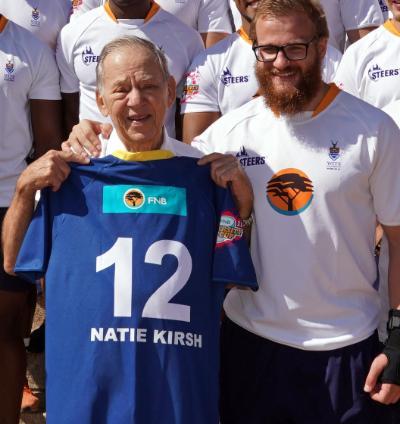
 On 24 August Professor Martin Veller (MBBCh 1979, MMed 1990), Dean of the Faculty of Health Sciences and professor in the University’s Department of Surgery, shared his insights from the coalface of the pandemic. He reflected on Wits’ response to the pandemic, how the health sciences faculty was navigating medical training and shared personal observations. Professor Veller said the Faculty ranked 77th out of 25 000 for clinical and preclinical disciplines in the Times Higher Education Ranking of Universities in the World.


 The Hand Behind The Invisible Hand


-400x566.jpeg "Lebohang Masango")


